CRO Audit: The Copy-First Framework You Can Run Yourself (Real 2026 Prices Included)
CRO audit guide: the UX-leak vs message-leak split, real 2026 prices (consultants $100-$300/hr, retainers $2,000-$10,000+/mo, projects $5,000-$50,000), a 5-check copy-first framework, Baymard abandonment data, and a worked example.
Your site gets traffic. The sales don't follow. You've read the page forty times, it reads fine, and fine gets scrolled past.
So you searched for a CRO audit, and the market offered you two doors. Door one: a consulting engagement priced somewhere between "book a call" and a director's signature. Door two: a free instant-audit tool that grades your page 92 out of 100 and then books you into a sales call. Neither door tells you the thing you actually came for: which line is losing the sale.
Here's our cards-on-the-table version instead. We're Just Digital, a proof-first marketing studio, and we sell one of the tools in this guide: Watson, a $9 one-time copy diagnostic. This article gives you the whole audit method anyway, with real 2026 prices, sourced numbers, and a framework you can run this afternoon at any traffic level. Run it by hand for free if you like. Watson just does the slowest part in about 10 minutes.
TL;DR
- A CRO audit is a structured examination of why visitors don't act, and it ends in a ranked list of fixes, not a dashboard. It hunts two leak families: UX leaks (WHERE people drop) and message leaks (WHY they don't buy).
- Most leaks are message leaks. Across Baymard Institute's meta-analysis of 50 studies, 70.22% of carts are abandoned, and the leading stated reasons (40% surprise costs, 19% card mistrust, 18% forced accounts) are persuasion problems, not layout problems.
- Real 2026 prices: CRO consultants charge $100 to $300 or more an hour, retainers run $2,000 to $10,000 and up a month, and project audits run $5,000 to $50,000 or more. One prominent agency's intake form starts its budget dropdown at $5,000+ a month and scopes its programme to sites with 100,000 monthly visitors.
- The market tell from our Semrush pulls: advertisers pay $15.42 a click for "conversion rate optimization tools" and $0.00 for "cro audit". Money chases tools. Almost nobody pays for diagnosis.
- The copy-first audit is 5 checks: traffic truth, offer, the 7 buying triggers, evidence, first fix. Watson runs the trigger scoring for $9, one time, report in about 10 minutes.
What Is a CRO Audit?
A CRO audit is a structured examination of why visitors don't take the desired action, ending in a ranked list of fixes. You'll also see it called a conversion rate optimization audit, a conversion rate optimisation audit, or simply a conversion audit. Same job in every spelling: evaluate the customer journey, find the leaks, rank them.
The useful distinction, and the one this guide is built on, is what kind of leak you're hunting. There are two families.
User experience (UX) leaks are mechanical friction points. The form breaks on mobile, slow page load times bleed visitors, confusing navigation sends people in circles, usability fails somewhere in the checkout flow. Analytics tools, funnel analysis, and session replays find these well, and the standard step-by-step audit guides cover them thoroughly.
Message leaks are psychological. The page loads perfectly and still fails to persuade: the headline names a category instead of a problem, the pricing hides the total, nothing on the page answers "why should I trust you with my card". Dashboards can't see these at all. A conversion rate optimization tools stack tells you WHERE people leave. It can't answer WHY.
| Leak family | What it is | Symptoms | What finds it | What it can't explain |
|---|---|---|---|---|
| UX leak (WHERE) | Friction in the mechanics | Rage clicks, high bounce rate, drop-off pages, slow loads | GA4, Microsoft Clarity, session replays | Why the persuasion failed |
| Message leak (WHY) | The words fail a buying trigger | "Reads fine", converts nothing | Copy diagnosis, buyer research | Where in the funnel the loss concentrates |
Most published audit frameworks run 9 to 12 steps of checklists and generic advice, and the message gets one checkbox somewhere around step 6. That ratio is backwards, and the data in a moment shows why.
A comprehensive CRO audit covers both families; a comprehensive audit that skips the message is half an audit. The industry verb is "optimize". The useful verb is diagnose.
A finished audit, whatever the audit framework, should hand you three actionable things: findings with evidence, priorities ranked by cost to your revenue, and one named first fix. If the audit process ends with "consider improving your CTAs", you paid for a horoscope.
What Does a CRO Audit Cost in 2026?
Published 2026 fee guidance puts experienced CRO consultants at $100 to $300 or more an hour, monthly retainers at $2,000 to $10,000 and up, and project-based audits at $5,000 for a focused landing page audit up to $50,000 or more (ClicksGeek's published fee guidance, verified August 2026).
The agency tier mostly refuses to print numbers at all. Speero, the agency arm of CRO training company CXL, gates pricing behind an enquiry form whose monthly budget dropdown starts at $5,000+ and climbs past $20,000+, and scopes its experimentation programme to companies with at least 100,000 unique visitors a month. That second number matters as much as the first: the flagship version of a professional CRO engagement quietly assumes traffic most sites don't have.
Here's the whole ladder, with prices:
| Route | Price band | Turnaround | Right when |
|---|---|---|---|
| Copy-first DIY audit (this guide) | $0 in tools + $9 Watson, one time | An afternoon | Any traffic level; diagnosis before spending |
| Consultant, hourly | $100 to $300+ an hour | Days to weeks | A specific question needs senior eyes |
| Project audit | $5,000 to $50,000+ | Weeks | Complex funnels, implementation included |
| Agency retainer | $2,000 to $10,000+ a month | Ongoing | Volume, budget, and a team to act on findings |
| Experimentation programme | Intake tiers from $5,000+ a month | Quarterly and beyond | 100,000+ monthly visitors |
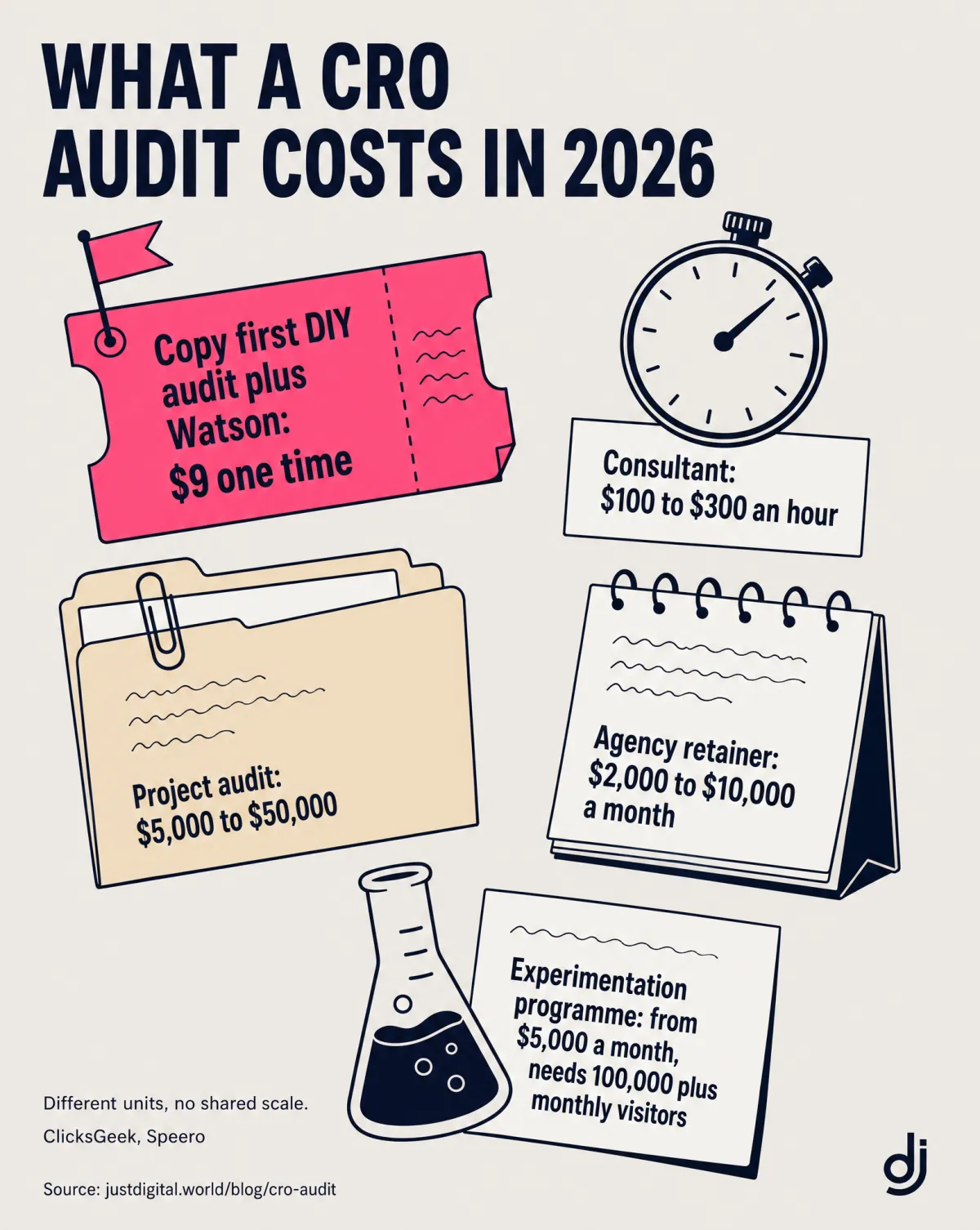
One more number, because it explains this whole market. In our July 2026 Semrush pull, advertisers paid $15.42 a click for "conversion rate optimization tools". In our August 2026 pull, "cro audit" costs $0.00 a click. The industry spends its ad budget selling you tools and leaves diagnosis, the step that decides which tool you even need, uncontested. That gap is why this guide exists.
And yes, the objection you're already forming is fair: another $9 tool is usually another prompt pack. Watson isn't a prompt pack. It reads your live page, scores 7 buying triggers, ranks every leak, and names the costliest one first. The guarantee, exactly as published: "Try it without risk. Run all 6 tools once each. If you don't find a single thing worth changing in your marketing, reply to your receipt and get the $9 back." The whole detective agency also ships as DomMCP, a $9 trial inside Claude, if you want every tool in one connector.
Why Are Most Conversion Leaks Message Leaks?
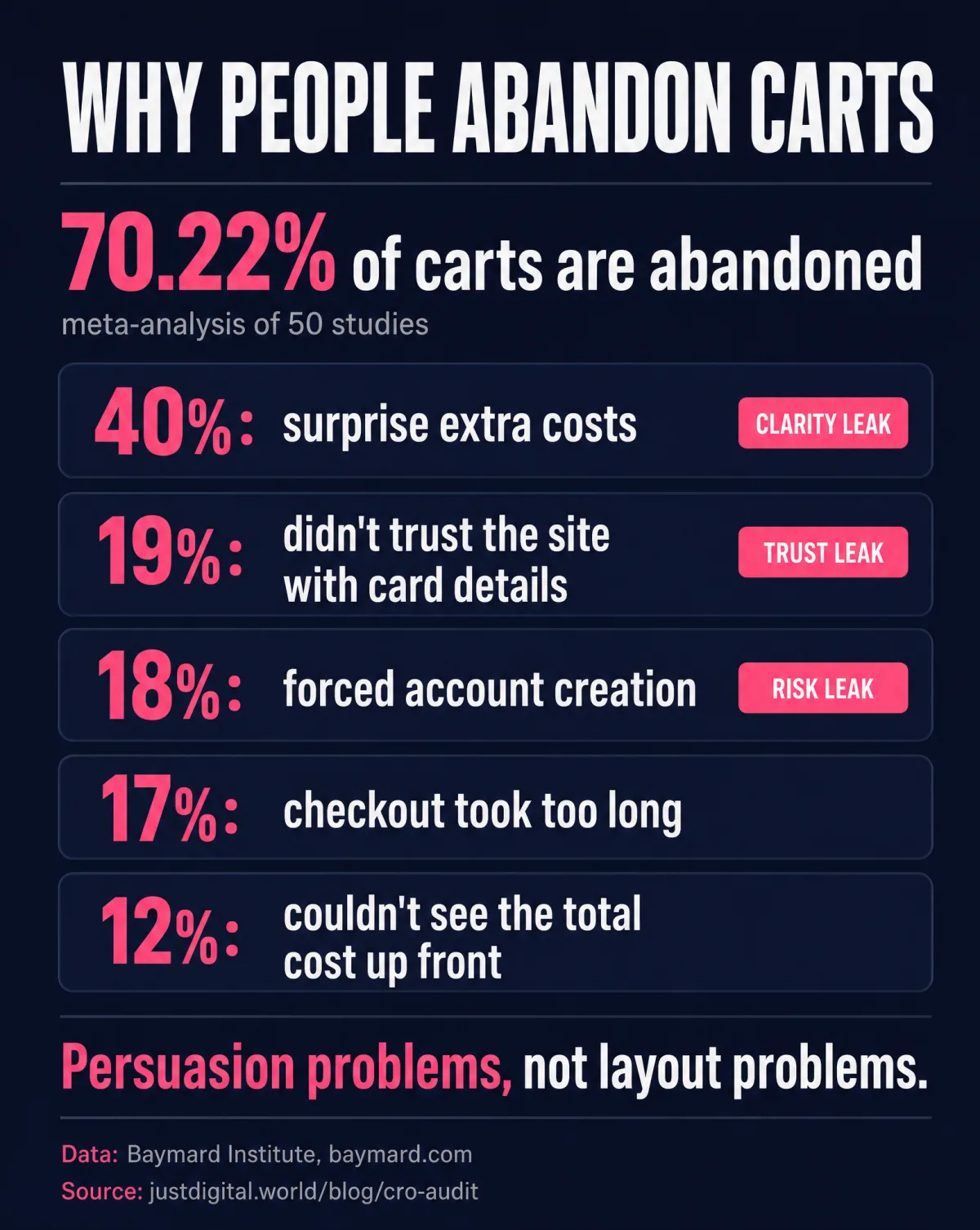
Across Baymard Institute's meta-analysis of 50 studies, 70.22% of carts are abandoned, and when US shoppers who intended to buy were asked why, the answers were persuasion-shaped: 40% named surprise extra costs, 19% didn't trust the site with their card details, 18% refused a forced account, 17% found checkout too long, and 12% couldn't see the total cost up front (Baymard Institute).
Read that list again as a copywriter rather than a UX designer. Surprise costs are a price-honesty failure. Card mistrust is a trust failure. Forced accounts are a risk failure. Those are message problems wearing checkout costumes: potential customers walking a checkout process that never answered their objections. And Baymard finds the average large e-commerce site can gain a 35.26% conversion lift from better checkout design alone, which is why every ecommerce website obsesses over its checkout flow. Most e-commerce CRO advice stops at the mechanics anyway. The recoverable money is enormous, and the reasons above say most of it leaks through the words.
| Stated abandonment reason (Baymard) | Share | The trigger it breaks |
|---|---|---|
| Extra costs too high (shipping, tax, fees) | 40% | Clarity (price honesty) |
| Didn't trust the site with card details | 19% | Trust |
| Forced account creation | 18% | Risk |
| Checkout too long or complicated | 17% | Action |
| Couldn't see total cost up front | 12% | Clarity |
A dashboard locates the exit. It never records the objection. Bounce rate, session length, average order value: every metric describes user behaviour after the persuasion already failed. Your heatmap can show a hundred people hesitating at the pricing table, and it will never tell you what the pricing table failed to say.
The words, meanwhile, measurably move money. Peer-reviewed research in the Journal of Consumer Research (Packard and Berger, 2021) found that when companies speak to customers in concrete, specific language, satisfaction rises 8.9% and follow-on spending rises about 13%. Concrete words are exactly what your buyers already use and your page probably doesn't.
If your page was written with artificial intelligence, this lands harder. The model optimises for fluency, so the draft always reads fine. But it never met your buyers, so it guessed their words, and the guesses fail triggers invisibly. It's not your prompts. It's missing evidence. We've written up the evidence-first message testing method and a line-by-line website copy audit walkthrough if you want that layer in depth.
How Do You Run a Copy-First CRO Audit?
Five checks, in order: traffic truth, offer, triggers, evidence, first fix. This CRO audit process works on homepages, landing pages, and product page templates alike, and each check ends in a decision, not a dashboard. Total time for a first pass through the conversion funnel: an afternoon.
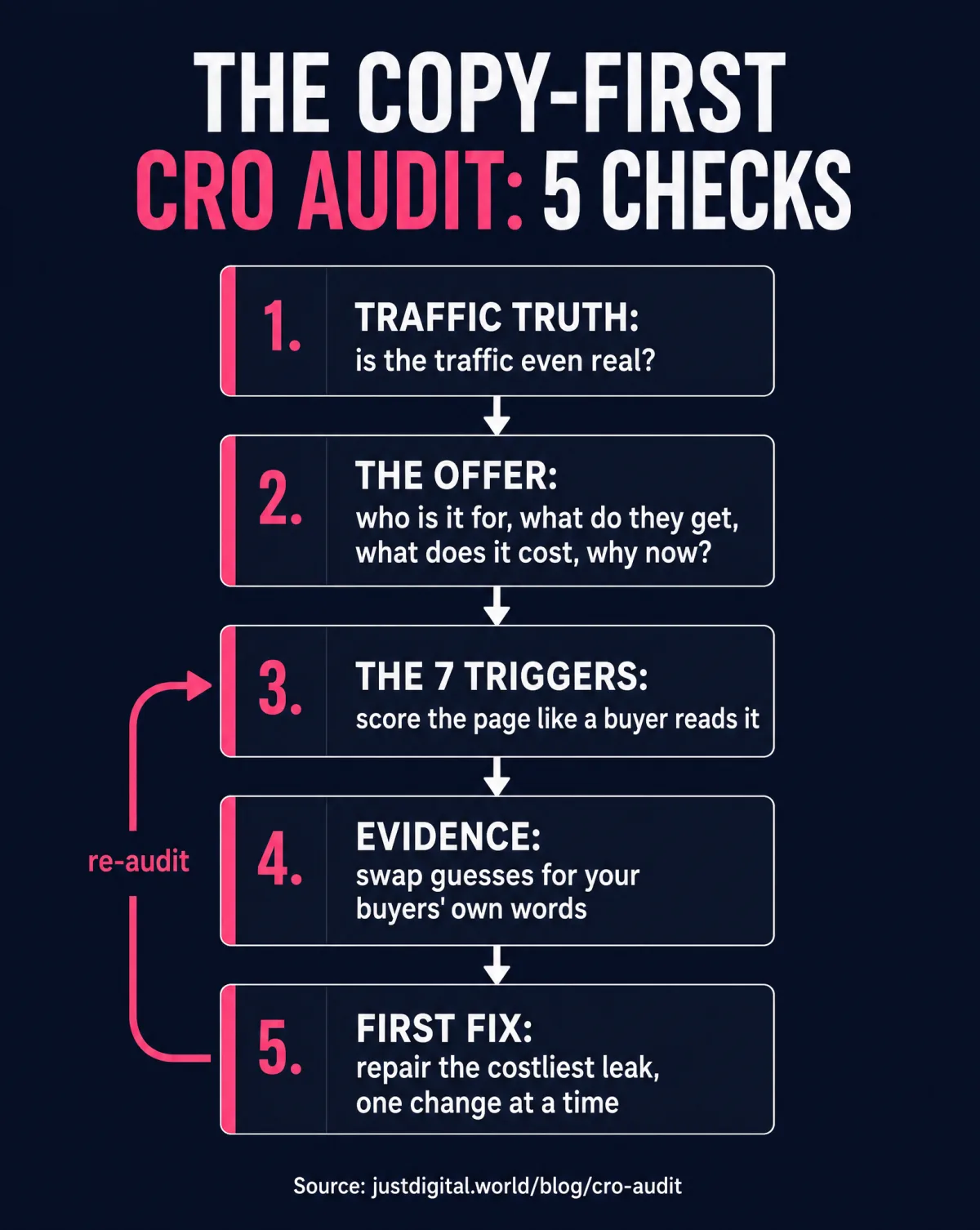
Check 1: Run the Traffic Truth Check
Verify the traffic before you audit the page. Broken tracking and recalled rankings both masquerade as conversion problems, and fixing copy for traffic that isn't real is a well-decorated waste of a month.
Three moves. Confirm your GA4 goals fire on the action, not the page load. Filter out your own visits (you are probably your most loyal visitor). Then read the traffic series by traffic source and look for cliffs. Speero's own services page states that 90% of the analytics setups they've seen are critically flawed, and our casework agrees with the spirit of that number: website performance and conversion rates get misreported more often than anyone admits. Benchmark the current series against last quarter before trusting either.
The cliff case is why this check comes first. Between 2021 and 2025, justinwelsh.me grew its organic search traffic about 480 times, then lost roughly 94% of it in six months after Google's December 2025 and March 2026 core updates. We pulled the Semrush series and published the full autopsy. No copy rewrite fixes that. And the standing lesson from that case applies to whatever your audit finds: rented traffic gets recalled, owned audience compounds, so put an email capture on any page you're about to improve. If the traffic layer itself is your problem, start with these search optimisation tips instead and come back.
Check 2: Check the Offer Before the Words
If you can't state who it's for, what they get, what it costs, and why now, the leak is the offer, not the words. Write the four answers down before touching any copy, and check they line up with your actual business goals. Not in your head. In writing, where vagueness has nowhere to hide.
Founders fail this check more often than they fail the copy. "A productivity tool for busy professionals" is a fog bank with a landing page. An audit can diagnose a message; it cannot invent one.
If you can't get the answers out of your own head, Lestrade, the intake interviewer in Watson's agency, exists for exactly this and stays free and unlimited. It asks until the answers exist. Pair the offer work with bottom-of-funnel keyword research and you'll also know the words buyers use when they're closest to paying.
Check 3: Score the Page Against the 7 Buying Triggers
Before anyone pays, their brain runs seven unspoken questions, and a page can pass every analytics check while failing four of them. Watson scores these as its diagnostic: Attention, Trust, Clarity, Urgency, Proof, Risk, and Action.
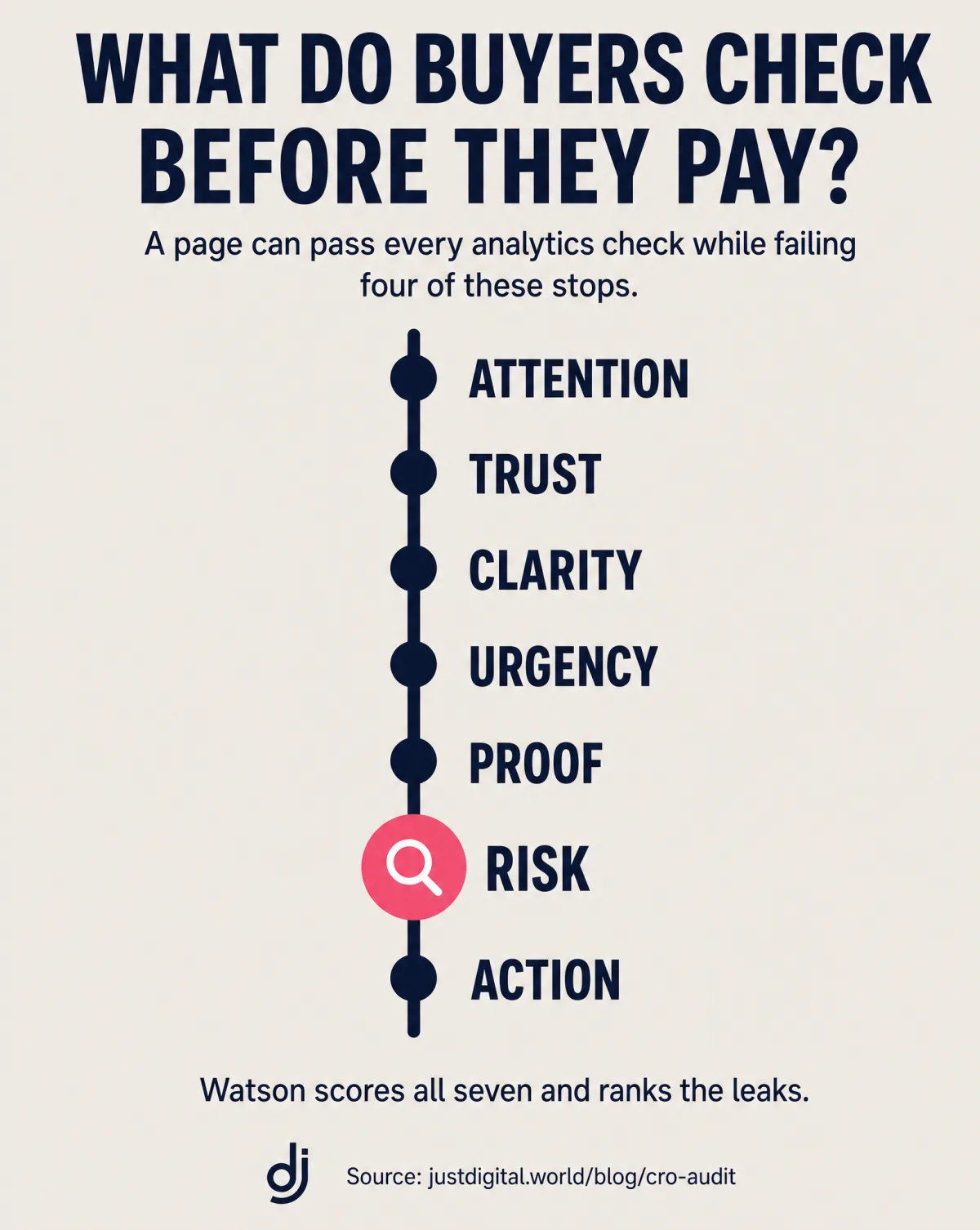
You can run the manual version right now: a CRO audit checklist in seven questions. Ask your page:
- Does the first line name a problem the buyer recognises as theirs? (Attention)
- Would a sceptic trust this page with a card number? (Trust)
- Could a stranger say what you offer after one read? (Clarity)
- Is there a reason to act now rather than someday? (Urgency)
- Is there a number or proof point a sceptic could check? (Proof)
- Does the page answer what happens if the purchase goes wrong? (Risk)
- Is the next step obvious and priced? (Action)
Every "no" is a leak. What the manual pass can't do well is rank them, and rank order is the whole game when you only have time to fix one thing this week.
That's the part Watson automates. $9, one time, no subscription. It investigates your homepage or landing page, scores all 7 triggers, ranks every leak, and opens the report with The Prime Suspect: the single costliest leak, named first. The report is in your hands in about 10 minutes, and setup inside Claude takes about 2 minutes with the included guide. For the page-level version of this check on a campaign page, the landing page audit walkthrough goes deeper.
Check 4: Replace Guessing With Evidence
The message that converts usually already exists in your buyers' own words. The failing triggers tell you where the page leaks. Buyer language tells you what to pour in.
The manual version: pull your reviews, sales-call notes, and support threads. That's richer qualitative data than most survey programmes ever collect, and it pairs with your quantitative funnel numbers to give the audit both halves (quantitative and qualitative data, the pairing every serious method preaches). Extract the phrases buyers repeat verbatim: their dreams, objections, and fears, in their words, not your summary of them. Then rewrite each failing line using the closest matching buyer phrase. Trust failures get answered with the exact doubts buyers voice. Clarity failures get answered with the words buyers use to describe what you do.
Sherlock does this automatically. It builds the Customer DNA report: the full psychological profile of your real buyers from their own words. One full Sherlock run is included with the $9 Watson purchase, so you see the depth before committing to anything; the full report is priced on getsherlock.io. Research panels do a version of this for teams with real budget, and we've written up panel-free message testing routes and alternatives to preference polls for everyone else.
Check 5: Fix the Costliest Leak First, Then Re-Audit
One change at a time, costliest leak first, then re-run the same diagnosis on the same page. This is how you improve conversion rate without gambling the whole page: regular CRO audits on a loop, not a one-off document. The score either moves or it doesn't, and both outcomes teach you something a redesign never would.
Resist the full rewrite. Fixing the top-ranked leak is usually the fastest way to increase your conversions, so change that one thing, hold everything else still, and give the change enough visitors to mean something before judging it. A/B testing joins the loop only when your traffic can actually call a winner, and the sample-size arithmetic (thousands of users per variant, at minimum) is laid out in full in our message testing guide. Below that volume, diagnose-fix-re-audit is the only version of CRO that produces decisions instead of noise. Once the winning lines exist, they feed straight into buyer-worded keyword targeting.
Ready to See Your Leaks Ranked? Run Watson
Get Watson and read your ranked list before you spend a cent on traffic or tools.
What Does a Worked CRO Audit Look Like?
A good audit ends with one named fix, not a redesign plan. Here's the five-check pass on a composite page we see weekly: an AI-written SaaS homepage. Composite means the tells below are drawn from real audits, with no single client's numbers attached.
Check 1, traffic truth. The GA4 "conversion" event turns out to fire on the thank-you page load, and the thank-you page is reachable by URL. A chunk of the recorded conversions are bots and the founder. Finding: fix tracking first; the conversion rate was fiction in both directions.
Check 2, offer. Asked "what exactly do they get for the price", the founder lists features for ninety seconds and never lands. The page does the same. Finding: the offer needs one sentence with a deliverable, a timeframe, and a price in it.
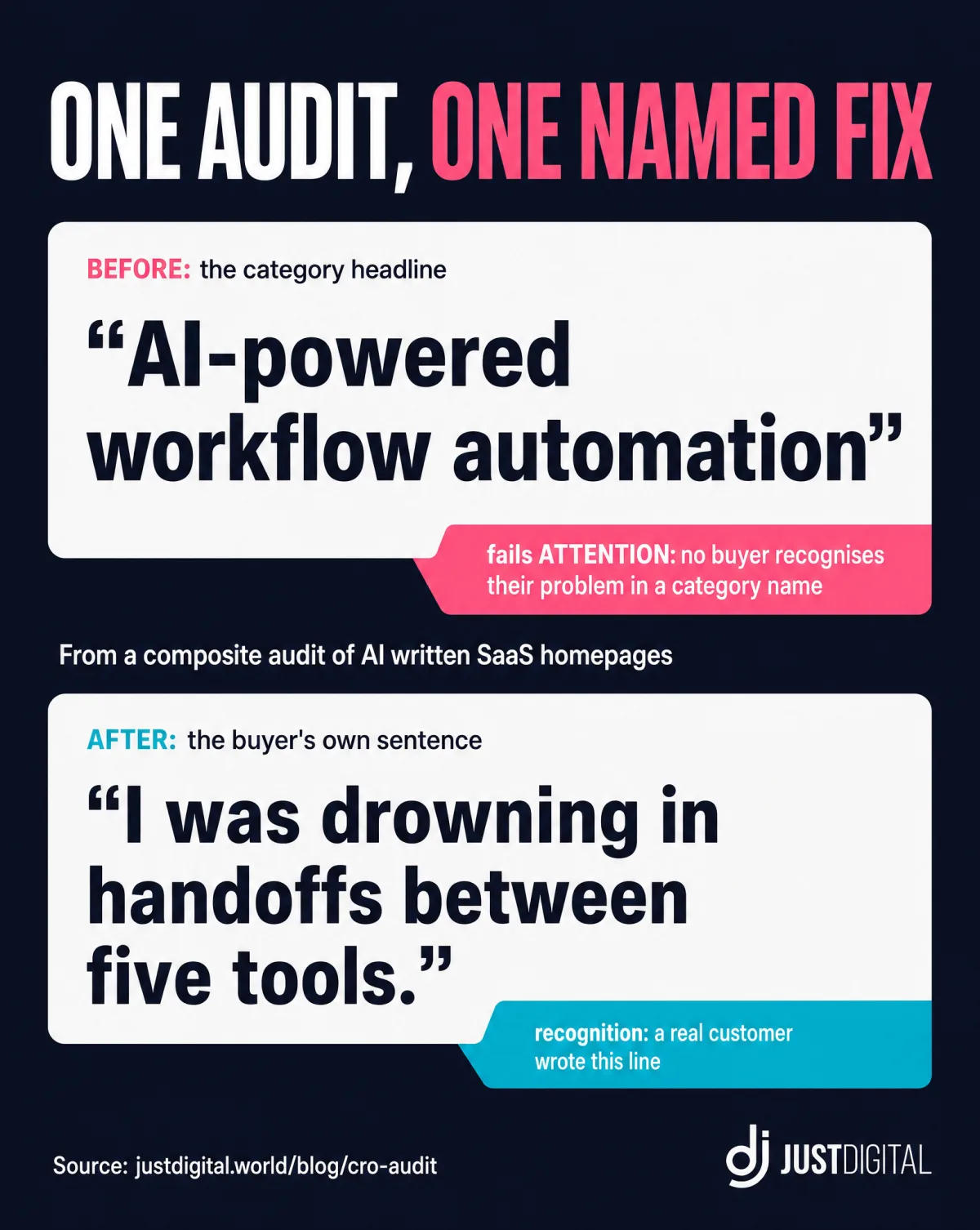
Check 3, triggers. The headline states a category ("AI-powered workflow automation"), which fails Attention: no buyer recognises their problem in a category name. Proof is a wall of logos with no numbers a sceptic could check. Risk is unanswered entirely: no refund terms, no "what happens after I pay". Three leaks, and the ranking matters: the unanswered Risk question sits closest to the money.
Check 4, evidence. The founder's own onboarding emails contain the sentence a real customer wrote: "I was drowning in handoffs between five tools." That line recognises a problem. It replaces the category headline.
Check 5, first fix. Answer Risk at the point of purchase: state the terms, plainly, next to the buy button. One change, then re-audit.
If you run client sites, note what just happened: that sequence is a pre-quote scoping document. The same $9 report works on a prospect's page before you price the engagement, so you walk into the pitch with the leaks already ranked.
And the edge case we promised to cover: sometimes all 7 triggers score well and sales still stall. Then the problem is upstream, in the offer or the audience, and no amount of copy polishing will move it. Watson telling you the copy is fine is worth the $9 by itself, because it ends the rewrite loop and points the work at the right layer.
Anton, founder of MVP Gurus: "It's done what would take hours and an expert to do." And: "The price point is nothing compared to the value." Vanjo, founder of Wolkk: "It described our buyers better than we could ourselves." "We changed our entire website the next day." The traffic-layer version of this walkthrough is public in the short autopsy.
When Should You Pay a Professional for a CRO Audit?
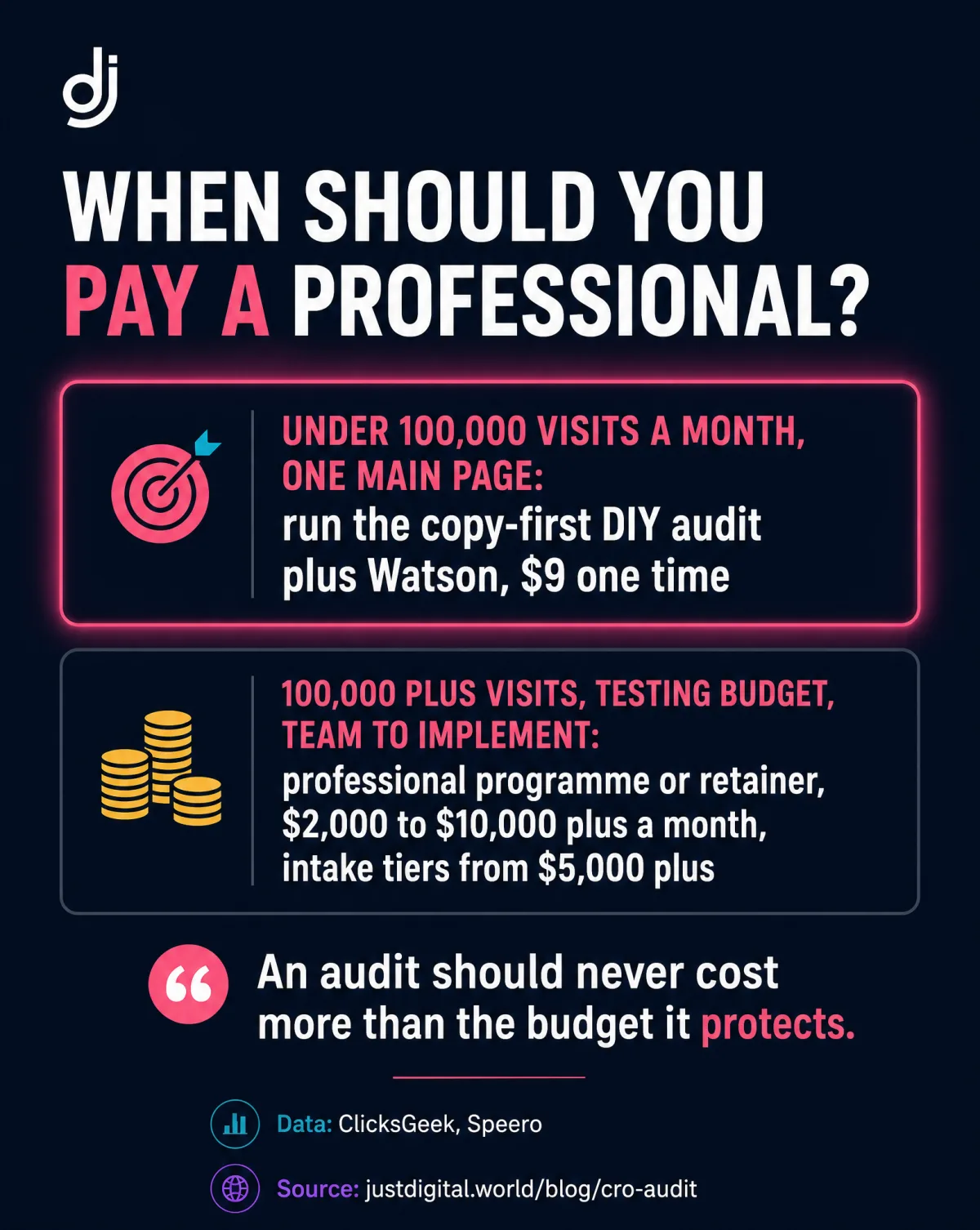
Pay for a professional audit when you have the traffic and the team to act on it. DIY-first is the rational default, not a religion, and there are real situations where the bigger engagement earns its fee.
The thresholds. A full experimentation programme, or a CRO agency retainer with a data-driven testing roadmap, makes sense at roughly 100,000+ monthly visitors, which is the gate a prominent agency itself applies to its own flagship service. Multi-property funnels (app plus site plus marketplace) can need measurement architecture a solo pass won't build. Compliance-heavy industries may need review layers baked in. And sometimes the constraint is hands, not knowledge: a retainer buys a team to implement fixes and improve the user experience at scale, not just findings.
The buy-order discipline holds either way: run the $9 diagnosis first and walk into any agency conversation holding your ranked leak list. It can shorten scoping on both sides, and it means you're buying execution rather than discovery at $200 an hour.
| Your situation | Right route | Cost band |
|---|---|---|
| Under ~100,000 visits a month, one main page | Copy-first DIY audit + Watson | $9, one time |
| Trigger failures need buyer-language evidence | Sherlock Customer DNA after Watson | One run included with the $9; full report priced on getsherlock.io |
| 100,000+ visits a month, testing budget, team to implement | Professional programme or retainer | $2,000 to $10,000+ a month; intake tiers from $5,000+ |
| Want it done for you, small scale | The studio takes a few engagements | By proposal; message Dom on LinkedIn |
Which Tools Do You Need for a CRO Audit?
Four tools cover all five checks, and three of them are free.
| Check | Tool | Cost |
|---|---|---|
| 1. Traffic truth | Google Analytics 4 + Microsoft Clarity | Free |
| 2. Offer | Lestrade (intake interviewer) | Free, unlimited |
| 3. Triggers | Watson | $9, one time |
| 4. Evidence | Sherlock (one run included with Watson) | Included once |
| 5. First fix | Re-run Watson on the fixed page | Part of the discipline |
What you don't need on day one: a paid heatmap and session recording suite (Microsoft Clarity covers watching for free), a testing platform (volume first), or a survey panel (your reviews and inbox already hold the language). Upgrade any layer only when a specific question demands it. The category-by-category comparison, with published market prices, lives in our conversion rate optimization tools guide.
Want the First Fix Named by Tonight? Start Your Case
Ten minutes from now you can know your costliest leak by name. Start your case at getwatson.io.
Frequently Asked Questions
What Is a CRO Audit?
A structured examination of why visitors don't act, ending in a ranked fix list:
- Two leak families: UX leaks (WHERE people drop) and message leaks (WHY they don't buy)
- Output: findings with evidence, ranked priorities, one named first fix
- Runnable yourself with the 5 checks in this guide
Note: most published frameworks audit the UX family thoroughly and give the message one checkbox.
What Does CRO Mean?
CRO stands for conversion rate optimization: raising the share of visitors who act (buy, sign up, book). Same letters, different worlds elsewhere: in pharma a CRO is a contract research organisation, and in sales titles it's a chief revenue officer. This guide means the website kind.
What Is the Difference Between a CRO Audit and an SEO Audit?
An SEO audit asks whether the right people arrive. A CRO audit asks why arrivals don't act:
- Traffic falling: run the SEO layer first (the traffic truth check decides)
- Traffic steady, sales flat: audit conversion
- The two share one discipline: evidence before changes
What Is a CRO Report?
The audit's output document. Watson's $9 version contains:
- All 7 buying triggers scored, hit or flagged
- Every leak ranked, with The Prime Suspect (your costliest leak) named first
- Watson's Notes on what to change first, and your next step
Report in about 10 minutes, reads in about 10 minutes.
How Much Should a Website Audit Cost?
Published 2026 bands: consultants $100 to $300+ an hour, retainers $2,000 to $10,000+ a month, projects $5,000 to $50,000+. The copy-first DIY route runs $9 total. A useful rule: an audit should never cost more than the budget it protects.
Is Watson a Subscription, and What if It Tells Me Nothing New?
No subscription: $9, one time. The guarantee, exactly as published: "Try it without risk. Run all 6 tools once each. If you don't find a single thing worth changing in your marketing, reply to your receipt and get the $9 back."
When Is Sherlock Worth It After Watson?
When the diagnosis shows Trust, Proof, or Clarity failures that need real buyer language to fix. Sherlock builds the Customer DNA report: the full psychological profile of your real buyers from their own words. One full run is included with the $9 Watson purchase, so you can preview the depth.
Can You Run a CRO Audit on a Low-Traffic Site?
Yes, and it's the rational first move there. You can conduct a CRO audit at any traffic level:
- An audit needs one page, not thousands of users per variant
- The loop: diagnose, fix the costliest leak, re-audit the same page
- A/B testing joins once traffic can call a winner (the sample-size math is in our message testing guide)
Get Updates Like This
Case studies land in the newsletter first, alongside AI marketing that converts and SEO that converts better. You get the receipts as they happen. I won't spam you, I promise.
Sources
- ClicksGeek, Conversion Optimization Consulting Fees (hourly, retainer, and project fee bands; verified August 2026)
- Speero, Customer Experience Optimization services (intake budget tiers, 100,000-visitor programme scope, analytics-setup claim; verified August 2026)
- Baymard Institute, Cart Abandonment Rate Statistics (70.22% average across 50 studies; abandonment reason percentages; 35.26% checkout-design lift)
- Packard and Berger, How Concrete Language Shapes Customer Satisfaction, Journal of Consumer Research 47(5), 2021 (8.9% satisfaction and about 13% spending lift from concrete language)