Wynter Alternative: The $9 Watson Diagnostic vs the B2B Panel (2026 Comparison)
Wynter alternative guide: Wynter's listed plans ($20,000-$100,000/yr, verified August 2026), per-test pay-as-you-go terms, panel model (80K+ verified B2B professionals), vs Watson $9 copy diagnostic (7 triggers, ranked leaks, 10-minute report). Comparison tables and FAQ.
You have the pricing page open in another tab. The plans are sized for a research programme. Your problem is one page of B2B copy that reads fine and doesn't convert, and the voice in your head is saying the objection we hear more than any other: "message testing panels cost thousands a year; I can't justify that for one page."
Most articles ranking for "Wynter alternative" are written by vendors ranking themselves first, and every one of them offers you another research panel or a broader research platform. If you're the marketer assembling the stack, that answer just moves the same bill sideways. This page does something different. It prints Wynter's live prices with a verification date, explains what a panel buys and what it doesn't, and then compares jobs instead of features. The cheap route here is Watson, our $9 one-time copy diagnostic. Some jobs still belong to a panel, and we'll tell you which ones.
Every number below carries a source. The Wynter figures were verified on their live pricing page on 20 August 2026.
TLDR: What Should You Know Before Choosing a Wynter Alternative?
- Wynter, as listed on their own pages at the time of writing: B2B message testing with a panel of verified professionals, subscriptions from $20,000 a year, a pay-as-you-go route priced per test at about 1.5 times the Pro-plan rate, results in 12 to 48 hours.
- Watson is a $9 one-time copy diagnostic. It investigates your page, scores 7 buying triggers, ranks the leaks costing you sales, and names the first fix. The report is in your hands in about 10 minutes, and the money-back wording on getwatson.io covers the whole $9.
- They do different jobs. A panel gathers reactions: how title-matched professionals read your page. A diagnostic names which line is leaking and what to fix first. Comparing them on features misses the point.
- A panel is still the right call when the stakes are five figures, you need senior titles' reactions in their own words, or the budget owner requires named human respondents. This article says so plainly, with the conditions listed.
- The deep research job has a third answer: Sherlock builds a Customer DNA report from your real buyers' words, and one run is included in the $9. Lestrade, the intake interviewer, stays free and unlimited.
What Does Wynter Actually Do, and What Does It Cost?
Wynter's listed plans start at $20,000 a year, with a pay-as-you-go route priced per test. Everything in this section comes from their own live pages, stated neutrally, because you came here for the numbers nobody prints.
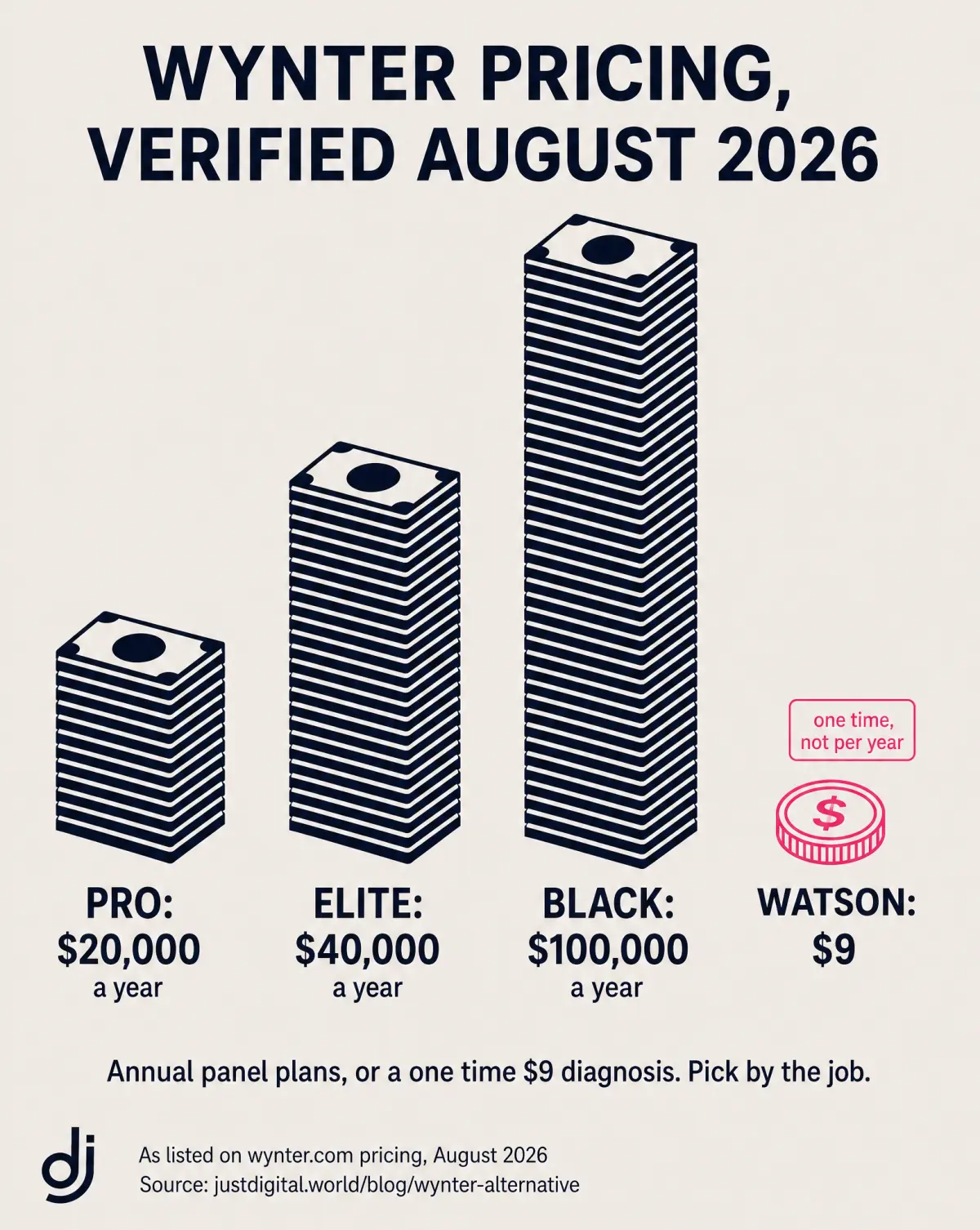
Wynter is a B2B message testing platform, one corner of the wider market research software world. Gartner tracks the job as its own category, B2B message testing solutions: tools that collect feedback from target buyers on messaging before it ships. Wynter's version, per their product page, runs your copy past a panel drawn from what they describe as 80,000+ verified B2B participants, with listed depth in SaaS and adjacent B2B audiences, and returns quantitative scores and qualitative quotes organised by question, role, and segment, per respondent. Their claimed turnaround is 12 to 48 hours from launch to results. Like most research panels, recruitment filters run on job title, seniority, company size, and geography.
Here is what their pricing page listed when we checked it on 20 August 2026:
| Plan | Listed price | What the page lists with it |
|---|---|---|
| Pro | $20,000/yr | 20,000 credits; listed per-test savings vs pay-as-you-go |
| Elite | $40,000/yr | 27,000 credits; a dedicated research advisor; a private Slack channel; up to 6 fully managed projects a year |
| Wynter Black | $100,000/yr | 70,000 credits a year; a 2-year contract incentive |
| Pay-as-you-go | Per test | No subscription; tests listed at about 1.5 times the Pro-plan rate; priced via an in-app calculator |
What the public pages don't list is a per-test dollar price. Their calculator page says the cost of each test depends on the type, size, seniority, and whether you subscribe, and the calculator itself sits behind a signup. If you want one number before a demo call, it isn't published, and that is itself useful to know.
One warning from the research for this article: third-party review sites still show older plan structures and lower figures that contradict the live page. Treat any undated "Wynter pricing" claim as expired, including this one after today, and check their pricing page directly.
For a funded research programme, those prices may be entirely rational. The question for you is narrower: does the job you need done this week cost that much at all? That depends on which of two very different jobs you're actually hiring for, and the listicles never separate them.
Are You Hiring a Panel or Buying a Diagnosis?
A panel gathers reactions; a diagnostic names the leak to fix first. They are different jobs at different prices, and "message testing" hides both under one label. We unpacked the method side of this in our message testing guide; here is the short version for the buying decision.
The reaction job asks: how do strangers with the right job titles read this page? You get scores and written comments back, and the comments are the product. The diagnosis job asks a narrower question: which line is losing the sale, and what do I change first? You get a ranked list back, with the interpretation already done.
That difference shows up on your desk:
| Output | A panel test | Watson |
|---|---|---|
| Raw material | Scores plus written comments from respondents | 7 buying triggers scored on the page itself |
| Interpretation | You translate comments into edits | Leaks ranked, each with its fix |
| First move | Yours to infer | Named: the Prime Suspect, then Watson's Notes |
| Iteration | Each round is a new test | Re-run after each fix; the report is yours |
There's a mechanism reason a page can be diagnosed without asking anyone. In five experiments at Princeton and Stanford, psychologist Daniel Oppenheimer showed that needlessly complex wording makes authors seem less intelligent, not more. Text that is easier to read is trusted more. Effects like that are testable against the page directly. A panel tells you fifteen people's reactions and leaves the mechanism work to you.
And neither job supplies the thing that decides most rewrites: the words your buyers already use. Those sit in your reviews, sales calls, and inbox, and no rented audience can produce them. That's the evidence-side gap our whole CRO approach is built around, and it's why the usual conversion rate optimization tools show you where visitors leave but not why.
What Does the $9 Watson Route Do Instead?
Watson scores 7 buying triggers, ranks the leaks, and names your first fix for $9, one time. Fully self-serve: no subscription, no demo call, and the price you just read is the whole price.
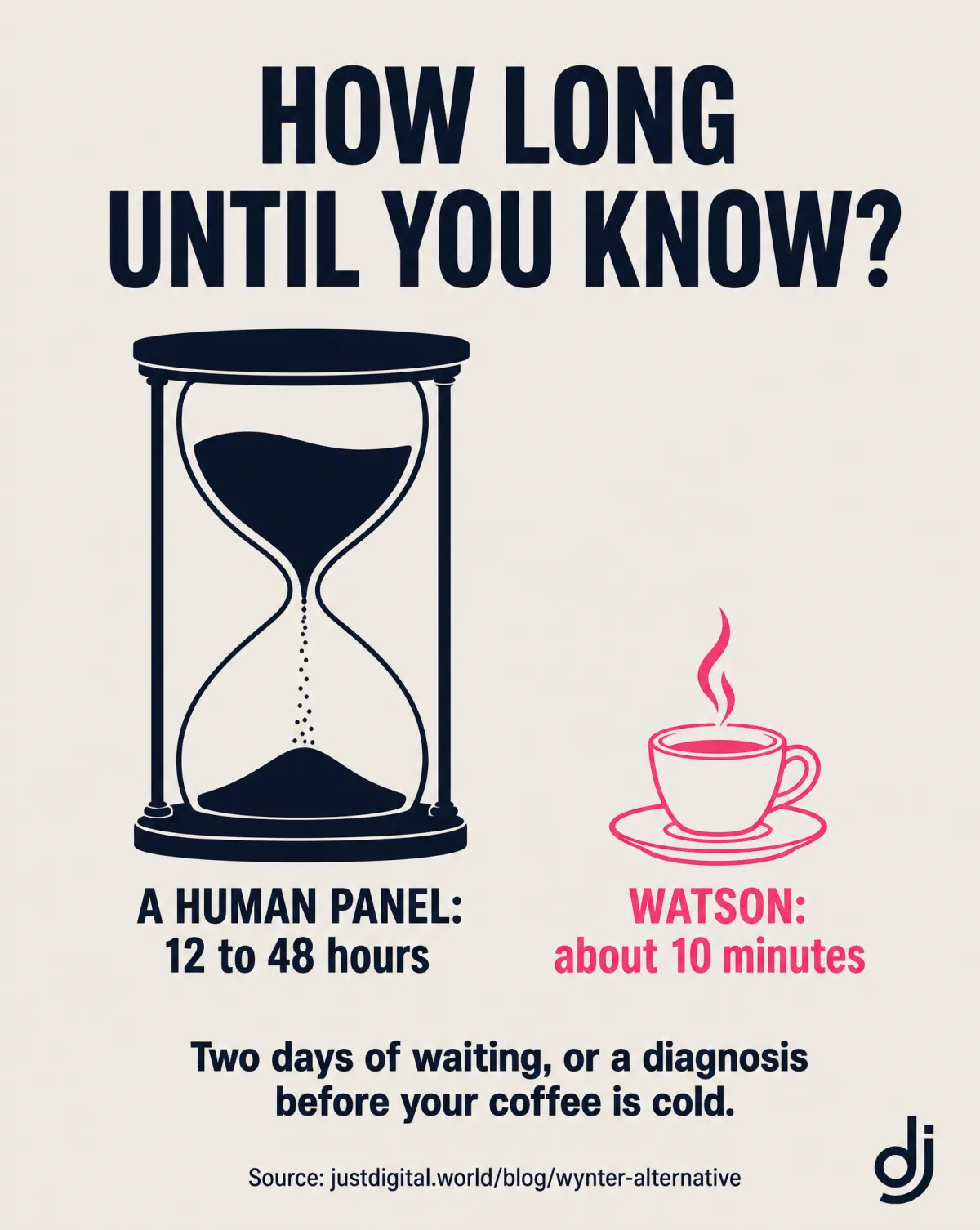
Here is the whole offer, as the product page states it. Watson investigates one page that's supposed to sell something: a homepage, landing page, sales page, or offer page. It scores the 7 psychological buying triggers it diagnoses against, by name: Attention, Trust, Clarity, Urgency, Proof, Risk, and Action. It ranks every leak it finds, each with its fix, names the Prime Suspect (the one leak costing you the most), and closes with your clearest next move. The report is in your hands in about 10 minutes and reads in about 10 minutes. It runs inside Claude, and setup takes about two minutes with the included guide. No technical skill needed.
If you do client work, the report has a second life: it's a scored artifact you can put in front of a client on Monday instead of an opinion. Anton, founder of MVP Gurus, put it this way: "It's done what would take hours and an expert to do."
The $9 also includes one full run of every other detective in the agency:
- Sherlock, the Customer DNA report: the full psychological profile of your real buyers, built from their own words
- Moriarty, the competitor teardown: what their unhappy customers complain about, and how to use it
- Virtual Dom, the marketing coach: asks the questions an expensive consultant would
- Google Quality Rater, the SEO check: reads your content the way Google's raters are told to
- Lestrade, the intake interviewer, stays free and unlimited
Now the objection you're already forming: a $9 AI tool sounds like a prompt pack with a detective hat on. Watson isn't a writing tool and doesn't generate copy. It's a diagnostic: it checks your existing page against how a buyer's brain reads it and tells you where the guessing shows. The rebuilding step, if you need one, runs on evidence from your own buyers via Sherlock, not on a cleverer prompt.
And the limits, stated plainly. Watson is not a human panel. It will not hand you quotes from real CMOs for a stakeholder deck, and it won't satisfy a procurement rule that says "named human respondents". If that's your constraint, the panel section below is for you.
The guarantee, exactly as the product page words it: "Try it without risk. Run all 5 tools once each. If you don't find a single thing worth changing in your marketing, reply to your receipt and get the $9 back."
Wynter vs Watson: Which Tool Does Which Job?
Match the tool to the job: reactions from a panel, diagnosis from Watson, and buyer language from Sherlock. This is not a feature war. The two tools barely overlap, which is exactly why the comparison is worth making by job instead.
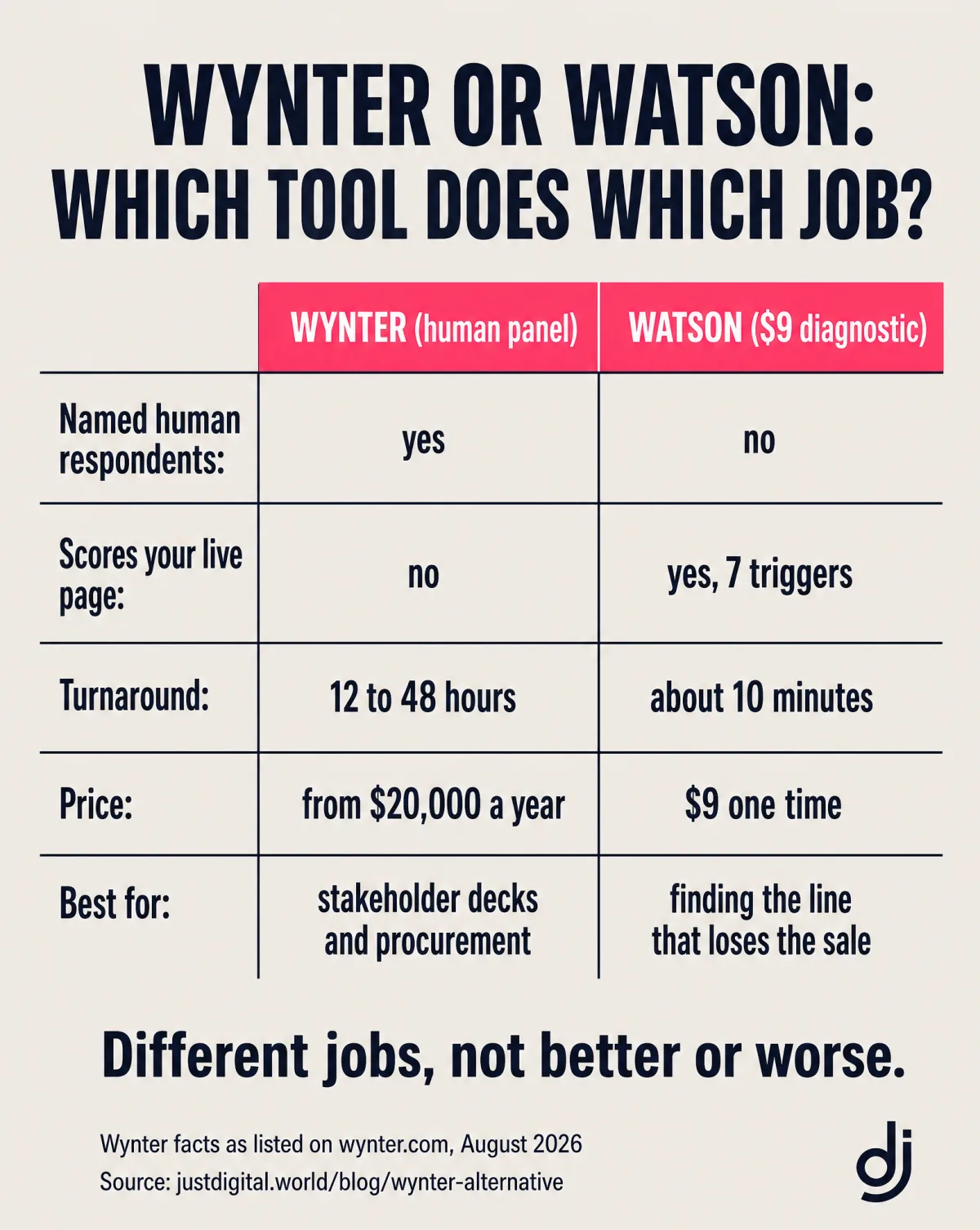
| Job to be done | A B2B panel (as listed) | Watson ($9 diagnostic) |
|---|---|---|
| Hear how senior titles read your page, in their words | Built for exactly this | Not this job |
| Find which line is leaking sales | Inferred from comments | Scored and ranked, fix named |
| Get a fix list you can act on today | You translate the comments | The report's native format |
| Check one page before ad budget spends | Per-test purchase, calculator-priced | $9, about 10 minutes |
| Feed real buyer language into the next draft | Panel words, rented audience | Sherlock, from your own buyers (run included) |
| Track brand perception over quarters | Panel and survey programme territory | Not this job |
| Show a budget owner defensible evidence | Named human respondents | Scored report with sourced triggers |
Three rows deserve prose. The exec-read row goes to the panel, without argument: if the decision hinges on how real CTOs phrase their scepticism, a verified human audience matched to your buyer persona is the tool. The which-line-leaks row goes to the diagnostic, because reaction data answers it only indirectly: someone still has to convert fifteen comment threads into an edit list, and that someone is you. And the buyer-language row belongs to Sherlock, because the highest-value words come from people who actually bought from you, not from a panel matched on job titles. The same logic drives high-converting keywords: source material from real buyers reads differently, and converts differently.
On the "can't I just run one test?" question: yes. Their pricing page lists a pay-as-you-go route with no subscription, priced per test at about 1.5 times the Pro-plan rate, with the exact figure behind the in-app calculator. A single panel test is a legitimate purchase. Just be clear it buys the reaction job, not the diagnosis job.
One more economic difference, because it changes behaviour: with a metered panel, every round of iteration is a new bill, so most teams test once and stop. The $9 report is yours. Fix the top leak, re-run, and watch whether the score moves. Iteration is the point, not an upsell.
When Is Wynter (or Any Panel) Actually the Right Call?
A panel is the right spend when the stakes outrun the research bill, and a $9 diagnostic is not a substitute on those jobs. Pretending otherwise would be the same vendor spin this article exists to avoid, so here are the conditions, stated as plainly as the prices were.
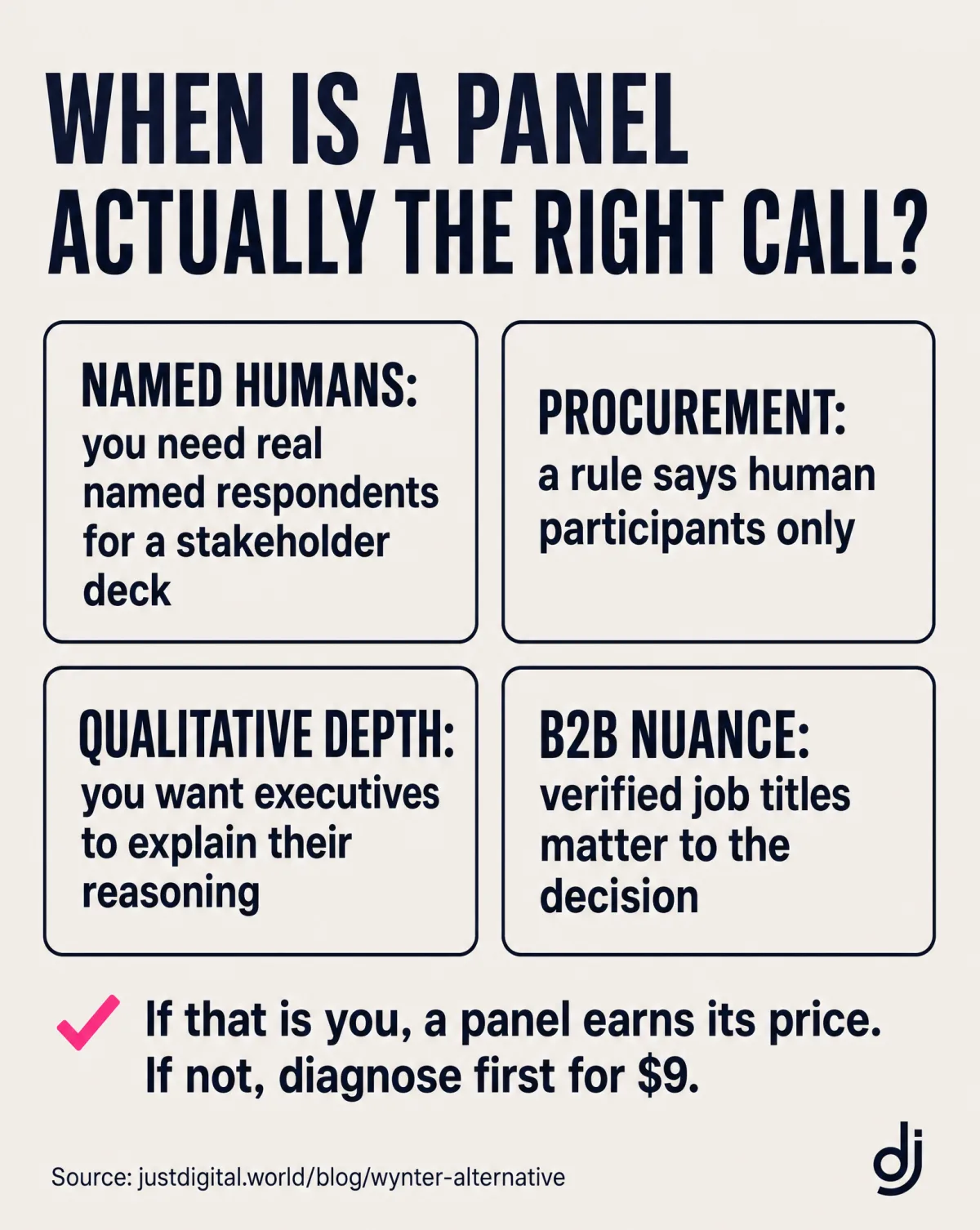
A panel earns its cost when:
- The decision at stake is five figures or more, so a message miss costs more than the research protecting it
- You specifically need how CTOs, CMOs, or VPs read the page, in their own words, not a proxy for them
- The budget owner's standard of proof is named human respondents, and no automated diagnostic satisfies that rule
- You're tracking brand perception over quarters, which is a research programme, not a page fix
- You run enough tests that subscriber rates beat one-off pricing, which is a research budget by definition
Below those conditions, the maths usually inverts: the research can easily outprice the decision it protects, and the rational order is diagnosis first, panel later with sharper questions and better evidence. If you arrived here comparing the lighter preference testing and concept testing panels instead (PickFu is the one we hear most), that's a different price class and a different comparison, and it has its own page.
If what's pulling you toward a panel is the deep question ("what do our buyers actually think?"), note that the panel answers it with strangers. Sherlock answers it with your own customers' recorded words. Vanjo, founder of Wolkk, after a Sherlock run: "It described our buyers better than we could ourselves."
What Does the Evidence Say About Testing Before You Spend?
Panels and diagnostics both give directional evidence; neither is a significance certificate. The research on this is clearer than the marketing around it, so here are the three numbers that size the whole category.
First, testing your message before spending is validated, full stop. The Advertising Research Foundation's Copy Research Validity Project, the only public study to validate copy testing measures against real split-cable sales results, found its strongest measure picked the better-selling ad in 84% of pairings, and the tested pairs were producing real sales differences of 8% to 41%. Choosing the wrong message costs real revenue. That finding supports the panel route and the diagnostic route alike.
Second, small qualitative samples are more defensible than most marketers assume. A 2022 systematic review in Social Science and Medicine by Monique Hennink (Emory University) and Bonnie Kaiser (UC San Diego) found qualitative studies typically reach saturation within 9 to 17 in-depth interviews. A panel of 10 to 15 professionals sits inside that range for a narrow question. So does a stack of 15 customer reviews you already own.
Third, statistical certainty is further away than either route admits. A 2022 paper at the ACM's KDD conference by Ron Kohavi (who ran experimentation at Microsoft and Airbnb), Alex Deng and Lukas Vermeer calculated that detecting a 10% relative lift at a 3.7% baseline conversion rate takes 41,642 real users per variant at standard rigour. No panel test and no diagnostic clears that bar. Both hand you a direction, not a proof, which is an argument for buying the cheaper direction first and saving the expensive instrument for the questions that survive it.
That order matters most where the click is closest to money: pages targeting bottom-of-funnel keywords are exactly where a message miss bleeds fastest. It's also how we work in public: the Justin Welsh case study exists because we'd rather publish the data than the adjectives.
How Do You Run the $9 Route in the Next 30 Minutes?
From purchase to first fix is about 30 minutes: $9, a two-minute setup, a 10-minute report. The timeline, straight from the product page:
- Buy Watson. $9, one time.
- Two-minute setup in Claude, guide included.
- Hand Watson your page URL.
- Report in about 10 minutes: triggers scored, leaks ranked, Prime Suspect named.
- Ship the first fix, then re-run to confirm the leak closed.
Sometimes the report will tell you the message itself is off, and polishing lines won't save it. Rebuild from evidence instead. That's what the included Sherlock run is for: it's customer research on material you already own, mining your reviews, calls, and inbox for the words buyers repeat so you can write from those. Lestrade handles the intake interview side free, without limits.
The risk maths at this price is short. The guarantee above covers the full $9, and the report stays yours either way.
And if you'd rather not run any of it yourself: the studio takes a small number of done-for-you engagements. Message Dom on LinkedIn.
Which Route Fits Your Situation?
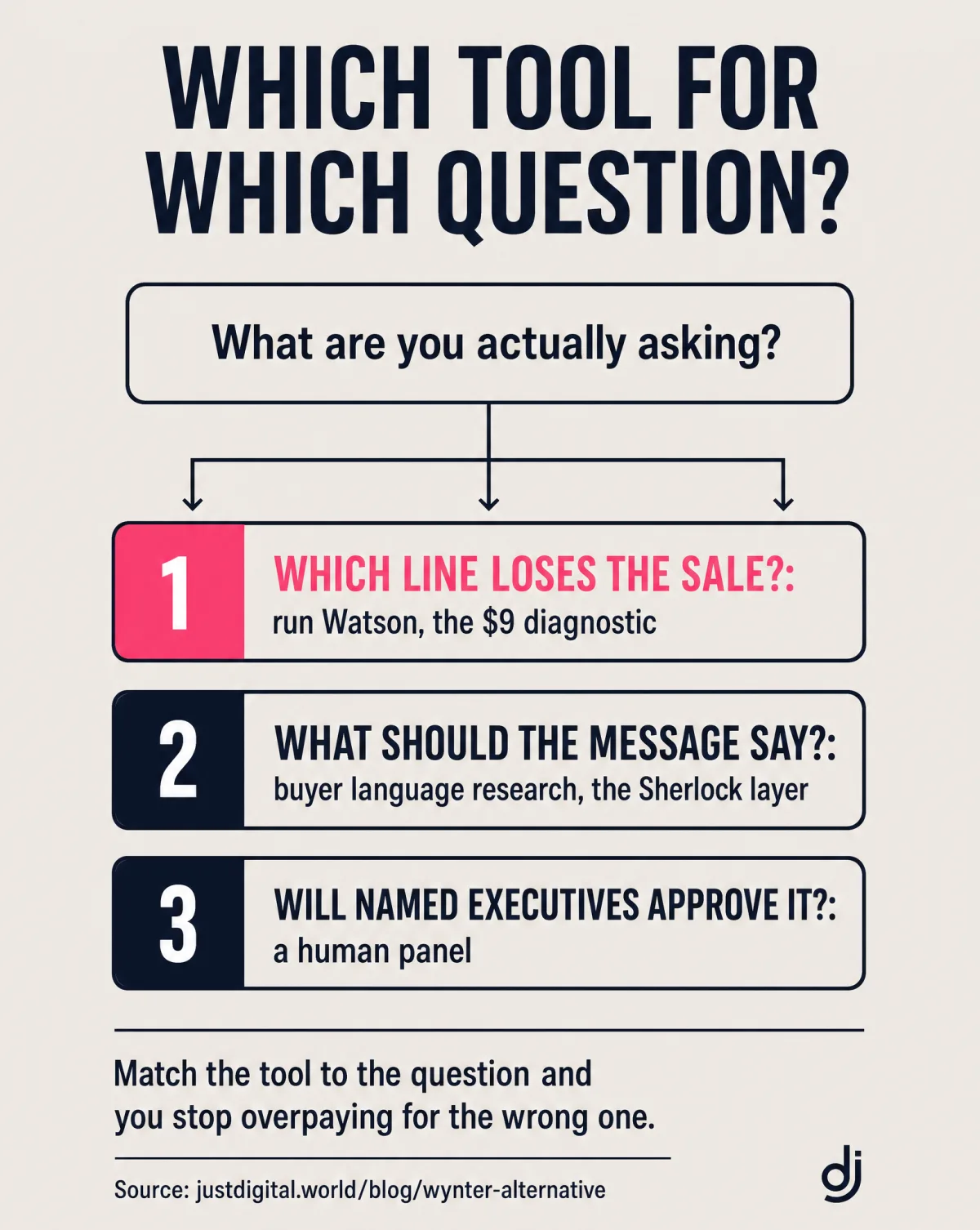
Start where your stakes and your evidence actually are, not where a vendor's funnel points. The routing, one line each:
| Your situation | Start with | Why |
|---|---|---|
| One page, this week, small budget | Watson | $9, about 10 minutes, ranked fixes |
| The message itself feels wrong | Sherlock, via the $9 run | Rebuild from your buyers' own words |
| Client work needing a scored artifact for Monday | Watson, per client page | The report is the deliverable |
| Five-figure launch, exec audience, research budget | A panel like the one you priced | Named human respondents, exec voice |
| Ongoing research programme with cadence | Panel subscription economics | Subscriber rates are built for that cadence |
| Not sure the page is even the problem | A CRO audit | Diagnose the funnel before the copy |
Whatever route you pick, pick it for the job. And if the job is "find the line losing the sale, today, for less than lunch", that decision was priced at $9. Run Watson first, and escalate with evidence.
Ready to See Your Page's Leaks? Run Watson for $9
Frequently Asked Questions
What Is Wynter?
Wynter is a B2B message testing platform, as their pages describe it at the time of writing:
- Panels of verified B2B professionals review your copy
- Output: scores and quotes organised by question, role, and segment
- Results claimed in 12 to 48 hours
Note: Gartner tracks this job as its own software category, B2B message testing solutions.
How Much Does Wynter Cost?
As listed on wynter.com/pricing on 20 August 2026:
- Pro: $20,000/yr with 20,000 credits
- Elite: $40,000/yr with 27,000 credits plus managed services
- Wynter Black: $100,000/yr; pay-as-you-go runs per test, listed at about 1.5 times the Pro-plan rate
Note: no public per-test dollar price is listed; the calculator requires signup. Check the live page; third-party price pages lag it.
Is There a Cheaper Alternative to Wynter?
Yes, if the job you need is diagnosis rather than panel reactions:
- Watson costs $9 one-time, no subscription
- It scores seven buying triggers on your page and ranks the leaks, report in about 10 minutes
- Money back if it tells you nothing new, per the wording on getwatson.io
However: it is a different job, not a discount panel. Panel-grade jobs stay panel-grade.
What Does Watson's $9 Include?
One diagnostic plus one run of every other detective:
- Watson: seven triggers scored, leaks ranked, first fix named
- Included once each: Sherlock (Customer DNA), Moriarty (competitor teardown), Virtual Dom (marketing coach), Google Quality Rater (SEO check)
- Lestrade, the intake interviewer, stays free and unlimited
Note: report in about 10 minutes; runs inside Claude with a two-minute setup.
What's the Difference Between a Panel Test and a Copy Diagnostic?
They answer different questions:
- A panel gathers reactions: how title-matched professionals read your page
- A diagnostic scores the page against buying triggers and ranks what to fix first
- Panels return quotes you translate into edits; a diagnostic returns the edit list
Note: the ARF's validation research backs testing generally; neither route is a significance certificate.
When Is a Panel Actually Worth the Money?
When the stakes outweigh the research bill:
- Five-figure launch or repositioning decisions
- You need senior titles' reactions in their own words
- The budget owner requires named human respondents, or you track brand over quarters
Note: below those stakes, run the $9 diagnostic first and bring better questions to any panel later.
How Do You Test Your Message With No Traffic and No Research Budget?
Use the evidence you already own:
- Mine reviews, calls, and inbox for your buyers' exact words; Sherlock builds this as a Customer DNA report (one run included in the $9)
- Score your draft with Watson's seven triggers before anything spends
- Lestrade handles intake free, unlimited
Note: rigorous A/B needs thousands of users per variant, so small sites are better served by evidence than by underpowered splits.
What Happens After Watson Finds the Leaks?
You fix the top leak first:
- The report names the Prime Suspect, the leak costing you most
- Each issue ships with its fix; Watson's Notes say what to change first and why
- Re-run after the fix to confirm the score moved
Note: if the diagnosis says the message itself is wrong, that's the Sherlock job: rebuild from your buyers' own words.
Get Updates Like This
Comparisons like this one land in the newsletter first, alongside AI marketing that converts and SEO that converts better. You get the receipts as they happen. I won't spam you, I promise.
Ready for the Deep Dive? Sherlock Reads Your Buyers' Minds
Sources
- Wynter's pricing page (their live plan listing; prices and turnaround verified 20 August 2026; factual reference, not an endorsement)
- Wynter's message testing product page (turnaround and output claims, verified the same day)
- The ARF Copy Research Validity Project, Journal of Advertising Research (split-cable sales validation; 84% pairing accuracy)
- Gartner, B2B Message Testing Solutions market (category definition)
- Hennink and Kaiser, Sample sizes for saturation in qualitative research, Social Science and Medicine, 2022 (saturation at 9 to 17 interviews)
- Kohavi, Deng and Vermeer, A/B Testing Intuition Busters, KDD 2022 (sample-size worked example, 41,642 users per variant)
- Oppenheimer, Consequences of Erudite Vernacular Utilized Irrespective of Necessity, Applied Cognitive Psychology, 2006 (processing fluency experiments)