PickFu Alternative: Poll Opinions or Diagnose the Evidence?
PickFu alternative comparison for conversion copy. Covers verified crowd-polling costs ($1/response, polls from $15), hypothetical bias (21%), intention-behaviour correlation (0.53), A/B sample-size floors (41,642 users/variant), cost ladder table, and Watson: $9 one-time, 7 buying triggers scored.
You've got the pricing tab open. You've done the maths: 50 respondents, a few targeting filters, one poll for the headline and another for the hero section. It's not the money that stops you. It's the quieter question underneath: what will 50 strangers' votes actually tell me about my buyers?
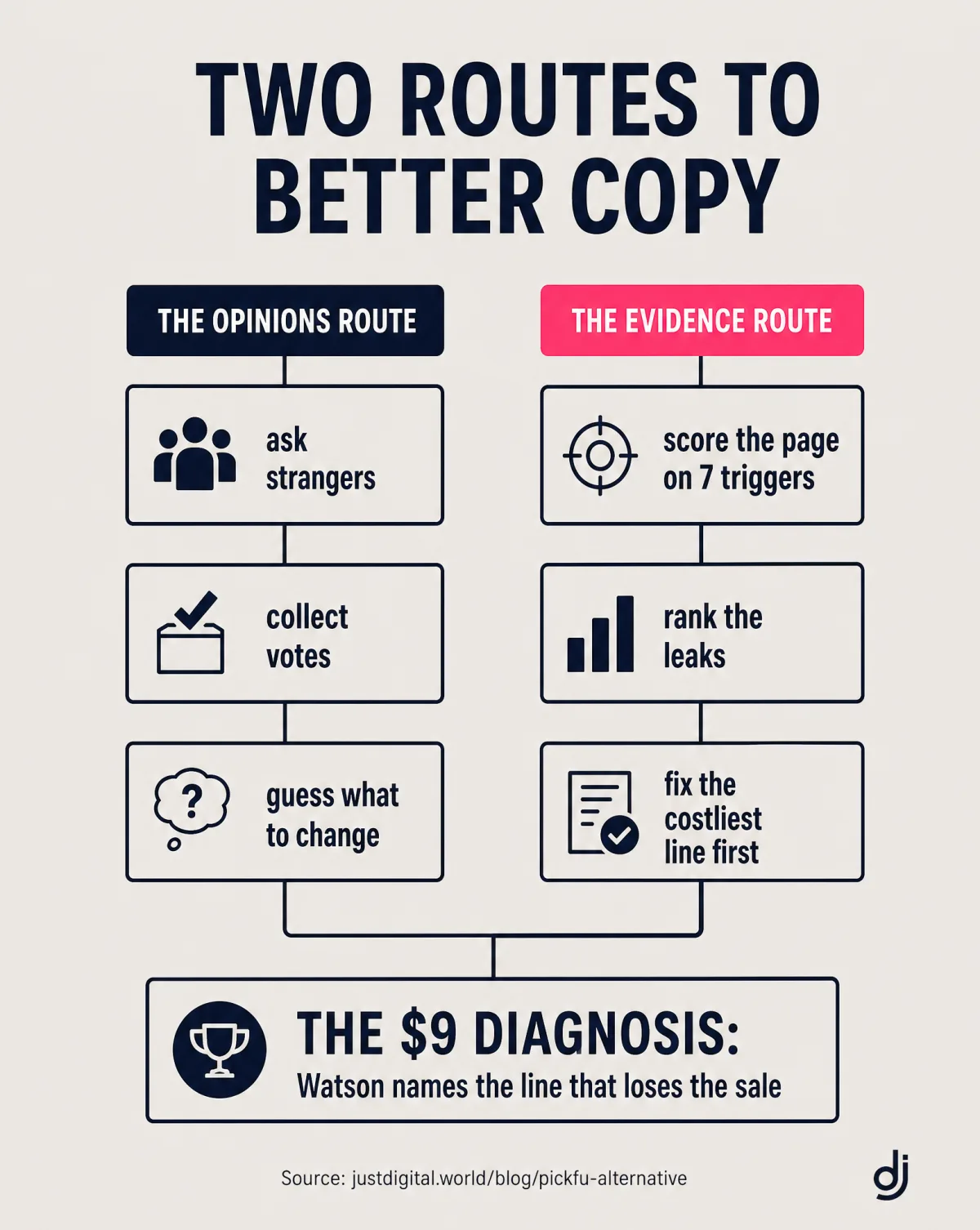
That question is the reason you searched for a PickFu alternative, and it deserves a straight answer, not another list of 13 lookalike panels reviewed by their own competitors. The job you're hiring a tool for is confidence: knowing the page will convert before the ad budget commits. Two mechanisms compete for that job. One polls strangers for their opinions. The other diagnoses your actual page against evidence.
This guide covers both: what a preference poll does well, what it structurally cannot do for conversion copy, what every route costs in one table, and which job each one fits. For the copy job, our recommendation is Watson: a $9 one-time diagnostic that scores seven buying triggers on your actual page, ranks the leaks, and puts the report in your hands in about 10 minutes. Every number in this guide is sourced, or it doesn't ship.
TLDR: What Should You Know Before Replacing a Preference Poll?
- PickFu, verified: a crowd preference poll. Panellists vote between your options and explain their choice. As listed on pickfu.com at the time of writing: responses from $1, polls from $15, 15 to 500 respondents standard, results within hours.
- The mechanical limit for conversion copy: panellists are not your buyers, and stated preference is not buying behaviour. Hypothetical willingness to pay overstates the real thing by 21% on average (Schmidt and Bijmolt, 2020).
- Watson is the $9 diagnostic route: seven buying triggers scored on your actual page, leaks ranked, first fix named, report in about 10 minutes, money back if it tells you nothing new. The $9 includes one full run each of Sherlock, Moriarty, Virtual Dom, and Google Quality Rater. Lestrade, the intake interviewer, stays free and unlimited.
- A preference poll keeps a real job: fast visual A/Bs. Book covers, thumbnails, package designs. Match the tool to the job: a poll for visual preference, Watson for copy leaks, Sherlock for buyer-language evidence, a live test only when thousands of users per variant exist.
What Does PickFu Actually Do?
A preference poll returns votes and comments from panellists, typically within hours. You post two or more options, and respondents drawn from a consumer panel pick the one they prefer and write a short explanation of why. The output is a vote split plus a stack of comments.
PickFu is a crowd polling platform built on that mechanism: consumer research that surveys real people in your target audience to validate creative decisions, as its own site describes it. The numbers below are as listed on pickfu.com at the time of writing; verify them yourself on the pricing page:
| Fact | As listed on pickfu.com at the time of writing |
|---|---|
| Per-response cost | From $1 (pay as you go) |
| Per-poll cost | From $15 |
| Respondents per poll | 15 to 500 standard (up to 1,000 on Enterprise) |
| Targeting | 90+ audience traits |
| Panel | 15M+ respondents worldwide |
| Subscriptions | $99 a month, or $999 to $9,999 a year in credit tiers |
| AI analysis | Included on every poll |
| Turnaround | "Get results within hours" |
The use cases its own site lists are consistent with the mechanism: Amazon product listings, gaming art and app-store materials, book titles and cover designs, ad creatives and copy, landing pages.
Those are the facts. The question is whether votes from a panel answer the question you actually have.
Why Do Founders Go Looking for a PickFu Alternative?
A poll can pick the option strangers prefer and still say nothing about whether your buyer will pay. The usual lists of alternatives to PickFu swap one panel for another: survey platforms, UX research tools, full market research firms. The three reasons people leave are about the mechanism itself, and they're worth taking seriously one at a time.
The first is cost at volume. "Panels cost real money per question; I can't justify that for one page." A single poll from $15 sounds harmless. But copy work is iterative: headline, hero section, pricing block, rewrite, re-test. Testing every rewrite turns a per-poll price into a recurring line, and the subscription tiers exist for exactly that reason.
The second is population. "Those panellists have never bought what I sell. Why would their vote count?" A consumer panel is a sample of the general public, not of your potential customers. Your buyer is defined by a situation: they were burned by an agency, they're screening you for risk, they have budget authority and a deadline. Demographic traits and interest filters can narrow a panel; they cannot select for that situation.
The third is the say-do gap. "People will click anything in a poll. It's not their money." This one has numbers behind it. A 2020 meta-analysis in the Journal of the Academy of Marketing Science (Schmidt and Bijmolt, 77 studies, 115 effect sizes) found hypothetical willingness to pay overstates real willingness to pay by 21% on average, and the gap grows for higher-priced and specialty products. Psychologists Paschal Sheeran and Thomas Webb, reviewing a synthesis of 422 studies, put the average correlation between measured intentions and later behaviour at 0.53. Meaningful, and a long way from a prediction.
There's an AI-era version of this search too. You wrote the page with AI, then rewrote it twice. It reads fine. Fine gets scrolled past. A poll of strangers rates how the page reads. It cannot tell you whether the page sells, and the conversion rate optimization tools in the usual stack can't either: they show where visitors drop off, never why. Consumer feedback at scale gives you opinions; the insight you're short of is what your buyer does at the moment of payment. That "why" layer is what a CRO audit is for, and it's the layer this comparison is really about.
Poll Opinions or Diagnose Evidence: What Is the Real Difference?
A poll measures preference between options. A diagnostic finds the leak inside one page. Everything else about this comparison follows from that one sentence.
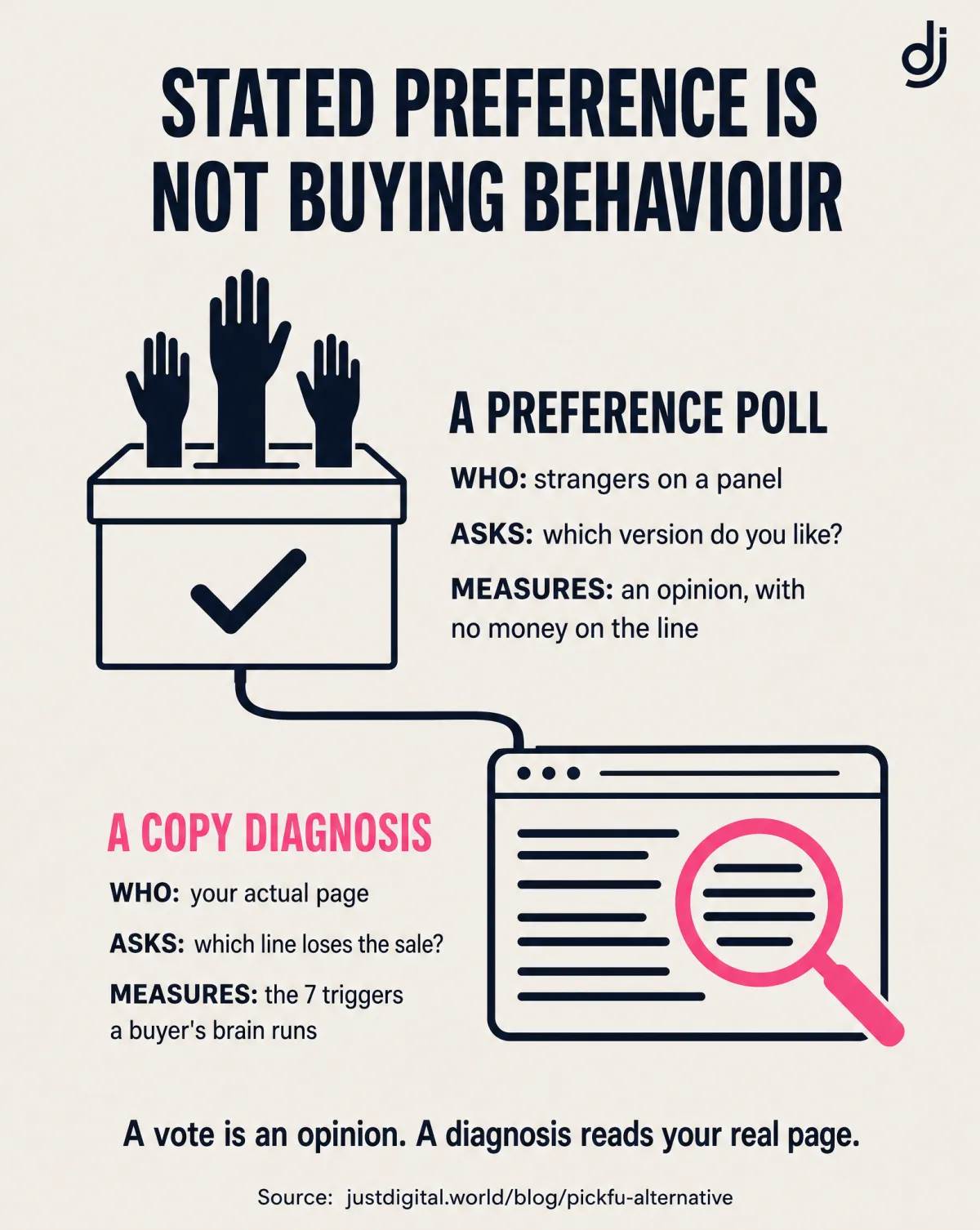
A preference poll works like this: you finish two or more variants, panellists state which they prefer and why, and you receive a distribution of opinions. A copy diagnostic works differently: the page itself is scored against the triggers that decide a sale, with real buyer language as the input, and you receive a ranked list of leaks with fixes.
The population problem sits under the first mechanism. A panel's 90+ targeting traits still can't select "people who were burned by an agency and are quietly asking whether you'll disappear after onboarding". Your buyer's mindset is a situation, not a demographic, and situation is what conversion copy has to answer. Population fit affects how much a panel's comments transfer to your page; for a niche B2B offer, often not much.
The incentive problem is harder, because it's structural. A vote costs the voter nothing. A purchase costs your buyer money, and that asymmetry determines what a poll can measure: opinions about options, never the willingness to pay for one. That's the 21% bias in mechanism form.
And here is the conditional part. Stated intentions do track sales sometimes. Forecasting research by Vicki Morwitz, Joel Steckel and Alok Gupta found stated purchase intentions track actual sales most closely for existing products and short time horizons, and the link weakens as the product and the buyer get further from the person being asked. A stranger-panel vote on a niche page sits at the weak end of that curve. A poll of your own recent customers about a product they already use sits at the strong end. Same mechanism, different population, different value.
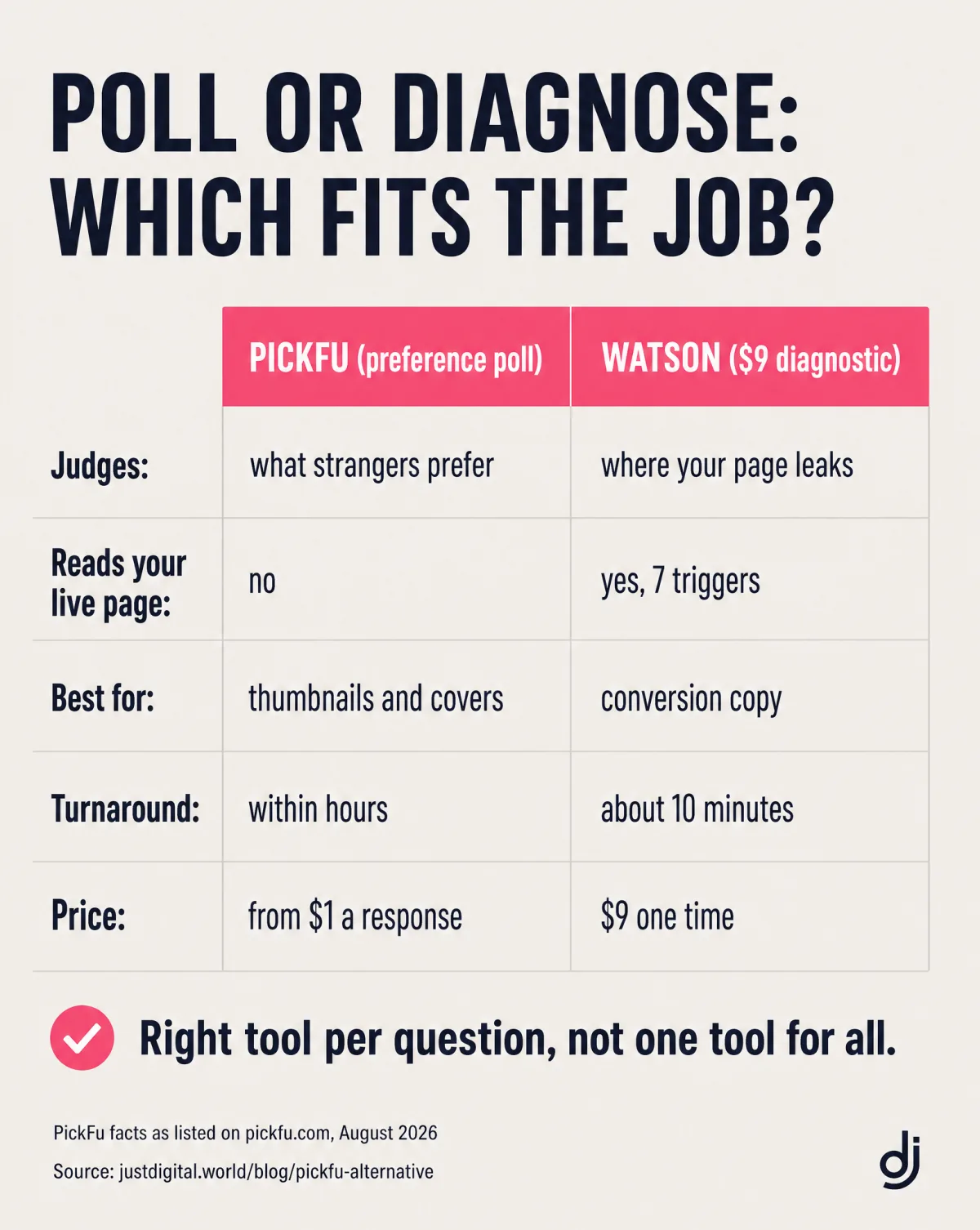
It cuts the other way too. A diagnostic cannot compare two finished visuals; it has no eyes for "which cover gets noticed". The two mechanisms answer different questions:
| Preference poll | Copy diagnostic | |
|---|---|---|
| Input | 2+ finished variants | Your live page (or draft) |
| Who answers | Panellists from a consumer panel | A scored framework fed with buyer evidence |
| Output | Vote split + comments | 7 trigger scores, leaks ranked, first fix named |
| Answers the question | "Which do strangers prefer?" | "Where does this page lose the sale?" |
| Blind spot | Whether anyone would pay | Which of two visuals gets noticed |
We watched the evidence side of this table play out on a real account in our message testing guide: pages rebuilt from buyer language, measured against the old expert framing, receipts on file.
Watson: The $9 Diagnostic That Reads the Page Itself
Watson scores seven buying triggers on your actual page and ranks the leaks, for $9, one time. No subscription. It investigates a homepage, landing page, sales page, or offer page, marks each trigger as a hit or a miss, ranks every issue it finds with its fix, and names the first fix before anything else. The report calls that first item The Prime Suspect: the one leak costing you the most.
The timeline is short enough to print. Buy Watson for $9. Setup inside Claude takes about two minutes with the included guide; no technical skill needed. Hand Watson your page URL. The report is in your hands in about 10 minutes, and it reads in about 10 minutes. Your first fix can be live within the hour.
If your doubt is "another $9 tool is probably another prompt pack", the difference is in what comes back. A prompt pack hands you inputs and leaves you to judge your own output, which is how you ended up polishing version 9 of the homepage. Watson hands you a verdict on your page: each of the seven triggers scored, every leak ranked, the next move named. You can run the same seven questions by hand first:
- Attention: does the first line name a problem your buyer recognises as theirs?
- Trust: is there anything on the page a sceptic could check?
- Clarity: could a stranger say what you sell after one read?
- Urgency: is there a reason to act now, without a fake countdown?
- Proof: is there a number with a source behind it?
- Risk: if the buyer is wrong, who carries the cost?
- Action: is the next step obvious and priced?
Every "no" is a leak. Watson runs that diagnostic automatically, ranks what it finds, and tells you where to start.
The $9 also includes one full run of every other detective in the agency: Sherlock builds the Customer DNA profile of your real buyers, Moriarty runs the competitor teardown from their unhappy customers' complaints, Virtual Dom asks the questions an expensive consultant would, and Google Quality Rater reads your content the way Google's raters are told to. Lestrade, the intake interviewer, stays free and unlimited. The whole set runs inside Claude.
The terms, verbatim from getwatson.io: "Try it without risk. Run all 5 tools once each. If you don't find a single thing worth changing in your marketing, reply to your receipt and get the $9 back."
Anton, founder of MVP Gurus: "It's done what would take hours and an expert to do." Vanjo, founder of Wolkk: "It described our buyers better than we could ourselves."
What Watson will not do: it will not pick between two book covers, it will not replace talking to your customers, and it will not hand you statistical significance. It finds the leaks in one page's copy. That is the whole job, and usually the one this search is really about.
Ready to See Which Line Loses the Sale? Run Watson
What Does Each Route Actually Cost?
A click from this search costs advertisers about $16.08. The whole diagnostic costs $9. That's the Semrush CPC for "pickfu alternative" (US database, August 2026), and it puts the prices below in perspective: the market values one visitor to a page like this above the cost of diagnosing your entire homepage.
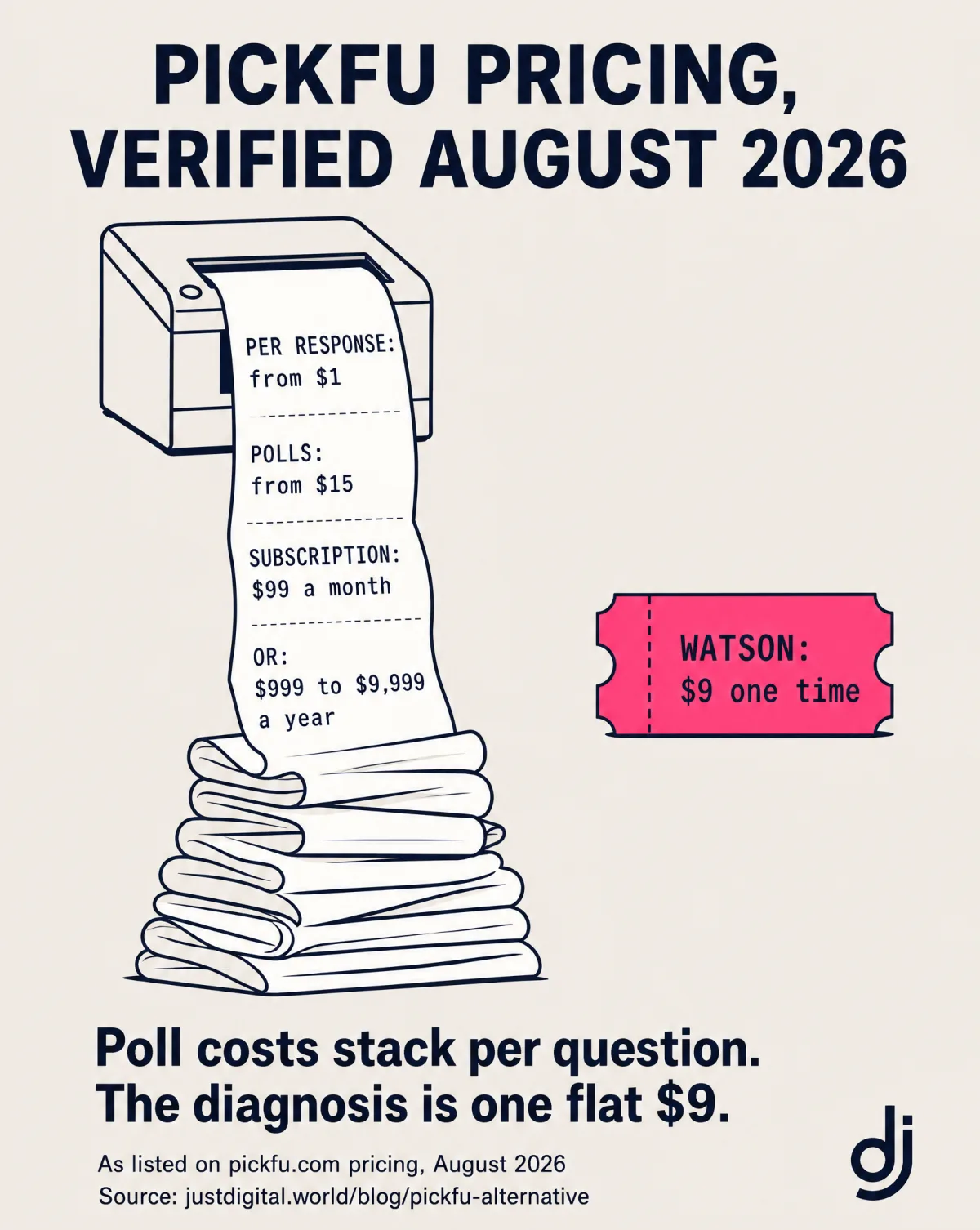
The buyer's rule for any test: it should cost less than the mistake it prevents. Here is the ladder, priced:
| Route | Cost | Turnaround | Right when |
|---|---|---|---|
| Crowd preference poll | Responses from $1; polls from $15 (as listed on pickfu.com at the time of writing) | Within hours (their claim) | The question is visual preference between finished options |
| B2B research panel | Quoted per test; typically annual contracts | Days | Budget exists and the stakes justify a niche panel |
| Watson copy diagnostic | $9, one time | About 10 minutes | The question is "where does my page lose the sale?" |
| Sherlock Customer DNA | Priced on getsherlock.io | Days | The message needs rebuilding from buyer evidence, not polishing |
| Live A/B test | Free to set up, priced in traffic | Weeks at small-site traffic | Thousands of users per variant are available |
Full-service market research sits above this table entirely: proposals, projects, weeks. And the last row needs its number stated plainly, because live split testing is the most common escape hatch and the least available one. In a 2022 paper at the ACM's KDD conference, Ron Kohavi, Alex Deng and Lukas Vermeer ran the numbers: at a 3.7% baseline conversion rate, detecting a 10% relative lift at standard rigour takes 41,642 users per variant. Below that, a split test collects noise with confidence attached. Most pages this article is written for will never see that traffic, which is why the ladder starts with diagnosis rather than ending with it.
When Is a Preference Poll Actually the Right Tool?
When the question is which visual gets noticed, a preference poll is the right tool. Some questions really are poll questions, and knowing which ones is what keeps the rest of this comparison fair.
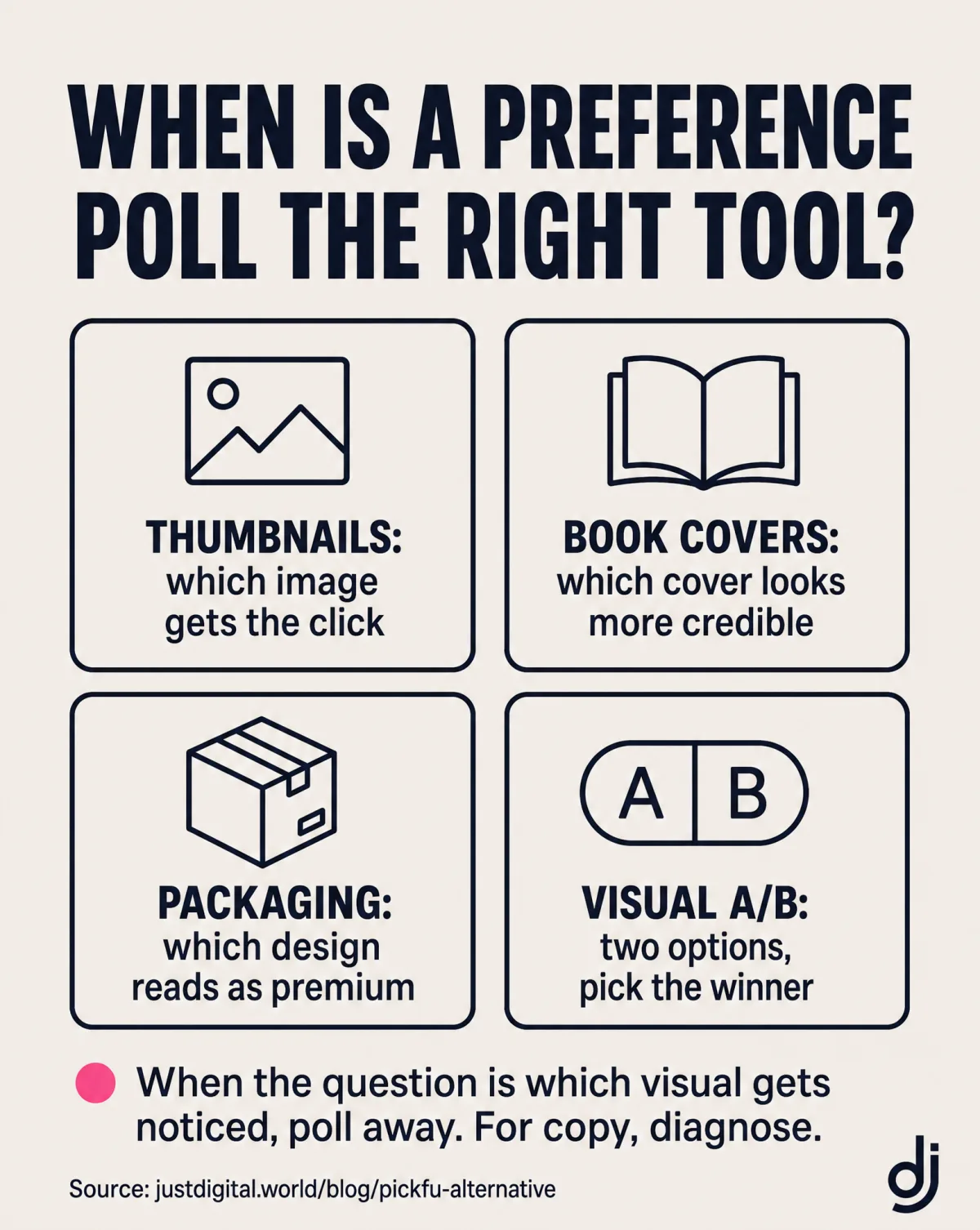
A crowd poll fits when three things line up: the question is visual, either option would work, and you need an outside eye today. That covers real jobs:
- Book covers and titles
- Video thumbnails
- Package designs
- Amazon listing images, the e-commerce sellers' classic use
- App-store art and icons
- Naming shortlists
- Pre-launch gut checks between two workable options, to test ideas before committing
Why does the mechanism hold there? Because noticing is not niche-dependent the way buying is. A stranger's eye is a fair proxy for "which of these gets seen on a crowded shelf?", even though a stranger's wallet is a poor proxy for "which of these would your buyer pay for?". Attention generalises across populations; purchase intent doesn't.
Testing before spending is itself well supported. The Advertising Research Foundation's Copy Research Validity Project, the field's only public study validated against split-cable sales data, found its strongest measure picked the better-selling ad in 84% of pairings. Testing works. The question is only which test fits which job.
The boundary sits exactly where the money starts. The moment your question shifts from "which gets noticed?" to "will my buyer pay?", the population and incentive problems return, and you're back in diagnostic territory. And if the tab you had open was a B2B message-testing panel like Wynter rather than a crowd poll, the same decision logic is worked through in our Wynter alternative guide.
How Do You Test Copy Against Your Real Buyers Instead?
The evidence for your copy already exists in your buyers' own words. Reviews, sales calls, support threads, the inbox. The method below digs it out before any panel gets paid, and each step names the tool that automates it.
- Pull the language your buyers already produced. Extract what they say verbatim: the hopes, the objections, the fears, the phrases they repeat. Their words, not your summary of their words. On volume: a 2022 systematic review in Social Science and Medicine by Monique Hennink and Bonnie Kaiser found qualitative studies typically reach saturation within 9 to 17 in-depth interviews when the audience is homogenous and the question specific. Your review pile and call notes are closer to enough than you think.
- Structure what you know with Lestrade. The intake interviewer is free and unlimited; it asks the questions that turn scattered knowledge into a usable brief.
- Run Watson on the page. $9, one time: seven buying triggers scored, leaks ranked, The Prime Suspect named first, report in about 10 minutes.
- Rebuild the leaking section in buyer words. When the message needs rebuilding rather than polishing, Sherlock builds the full psychological profile of your real buyers: the Customer DNA report. Watson finds the symptoms; Sherlock finds the cause.
- Re-run Watson, then let the live account judge. Score the rebuilt page, ship it, and watch cost per click and conversion at modest budget. The live account gives a directional verdict rather than a significance certificate, and directional is what a small site can afford.
The same buyer-language discipline pays twice: the words that convert on the page are usually the words worth ranking for, which is the thread running through our high-converting keywords and bottom-of-funnel keywords guides.
One more thing for the marketer running this for clients: the Watson report doubles as the client-readable artefact. A scored report you can put in front of a stakeholder and say: this is why, here is the first fix.
Which Route Fits Your Job? The Decision Table
Route the job, not the brand: visuals to a poll, copy leaks to Watson, message evidence to Sherlock.
| Your question | Right route | Cost | Turnaround |
|---|---|---|---|
| "Which cover, thumbnail, or pack design?" | Preference poll | Polls from $15 (as listed at the time of writing) | Hours |
| "Where does my page lose the sale?" | Watson | $9, one time | About 10 minutes |
| "What should the message even say?" | Sherlock (Customer DNA) | On getsherlock.io | Days |
| "What do I actually know about my buyers?" | Lestrade (intake interview) | Free, unlimited | Same session |
| "Which variant wins at scale?" | Live A/B | Priced in traffic | Weeks; needs thousands of users per variant |
If you arrived here with a conversion-copy question, the sequence is short: start with the $9 diagnostic, keep the poll for your next thumbnail, and go to Sherlock when the diagnosis says the message itself is the problem. Not ready to spend anything? Lestrade costs nothing and starts the same evidence file.
This is the same evidence-over-polish discipline behind our published Justin Welsh case study: pull the data, state what it says, keep the receipts. For hands-off work, the studio takes a small number of engagements; message Dom on LinkedIn.
One Page, Seven Triggers, $9: Start Your Case
Frequently Asked Questions
What Is a Cheaper Way to Test Conversion Copy Than Paying Per Poll?
Watson is a $9 one-time copy diagnostic, no subscription: it scores seven buying triggers on your actual page, ranks the leaks, and names the first fix, with the report in your hands in about 10 minutes.
- The $9 includes one full run each of Sherlock, Moriarty, Virtual Dom, and Google Quality Rater
- The money-back wording is printed on getwatson.io
- No panel is involved, so the price doesn't scale with respondents
Note: cheap only matters if the mechanism fits; for a visual A/B, a preference poll remains the fitting tool.
Can You Test a Landing Page With No Traffic?
Yes. Diagnosis needs a page, not visitors, so a pre-launch page with zero traffic can be checked for $9.
- Watson scores the draft or live page against seven buying triggers
- Lestrade interviews you free to structure what you know
- Buyer language comes from reviews and calls you already have
However: a live A/B really does need traffic, thousands of users per variant, for a rigorous verdict.
What Does Watson's $9 Include?
The Watson report: seven buying triggers scored, leaks ranked, first fix named, in about 10 minutes. Plus one full run each of Sherlock, Moriarty, Virtual Dom, and Google Quality Rater.
- Lestrade stays free and unlimited
- Setup inside Claude takes about two minutes with the included guide
- No subscription
The terms, verbatim from getwatson.io: "Try it without risk. Run all 5 tools once each. If you don't find a single thing worth changing in your marketing, reply to your receipt and get the $9 back."
Do Poll Results Predict Actual Sales?
Partially, and under conditions. Measured intentions correlate with later behaviour at 0.53, and hypothetical willingness to pay overstates the real thing by 21% on average.
- Stated intent tracks sales most closely for existing products over short horizons
- The gap grows for higher-priced and specialty products
- A vote costs nothing; a purchase costs money
Note: treat poll output as evidence about opinions, not a sales forecast.
Should You Still Use a Poll for a Book Cover or Thumbnail?
Often, yes. Noticing is not niche-dependent the way buying is, so a stranger's eye is a fair proxy for "which of these gets seen?".
Note: the moment the question becomes "will my buyer pay?", the population and incentive problems return; switch to diagnosis.
How Does PickFu Work?
You post two or more options, and panellists from its consumer panel vote for the one they prefer and write a short explanation. As listed on pickfu.com at the time of writing, polls run 15 to 500 respondents and results arrive within hours, with responses from $1.
Note: the output is a preference distribution; what it tells you depends on whether your question is preference-shaped.
How Much Does PickFu Cost?
As listed on pickfu.com at the time of writing: pay-as-you-go responses from $1 each, individual polls from $15, and subscriptions at $99 a month or $999 to $9,999 a year in credit tiers.
Note: compare cost per decision, not per response; the cost ladder above does that.
5 Ways We Can Help You
- Run Watson on your page: $9, one time, seven buying triggers scored, leaks ranked, first fix named in about 10 minutes
- Use the included runs: Sherlock, Moriarty, Virtual Dom, and Google Quality Rater, one full pass each on the same $9
- Start free: Lestrade, the intake interviewer, unlimited and free
- See the method on a real account in the message testing guide
- For done-for-you work, message Dom on LinkedIn; the studio takes a small number of engagements
Get Updates Like This
Case studies and receipts land in the newsletter first, alongside AI marketing that converts and SEO that converts better. You get the receipts as they happen. I won't spam you, I promise.
Sources
- PickFu pricing page (per-response and per-poll pricing, respondent counts, subscription tiers; checked at the time of writing)
- Schmidt and Bijmolt, Accurately measuring willingness to pay for consumer goods: a meta-analysis of the hypothetical bias, Journal of the Academy of Marketing Science, 2020 (21% average hypothetical bias; 77 studies, 115 effect sizes)
- Sheeran and Webb, The Intention-Behavior Gap, Social and Personality Psychology Compass, 2016 (r = 0.53 across a synthesis of 422 studies)
- Morwitz, Steckel and Gupta, When do purchase intentions predict sales?, International Journal of Forecasting, 2007
- Kohavi, Deng and Vermeer, A/B Testing Intuition Busters, KDD 2022 (41,642 users per variant at a 3.7% baseline)
- Hennink and Kaiser, Sample sizes for saturation in qualitative research, Social Science and Medicine, 2022 (saturation at 9 to 17 interviews)
- The ARF Copy Research Validity Project, Journal of Advertising Research (84% pairing accuracy, split-cable sales validation)