Bottom of Funnel Keywords: Why the Ones That Convert Aren't in Your Keyword Tool
The keywords that convert aren't in your keyword tool. 6 types, real client receipts, a 6-step strategy, and the buyer-language method that finds them.
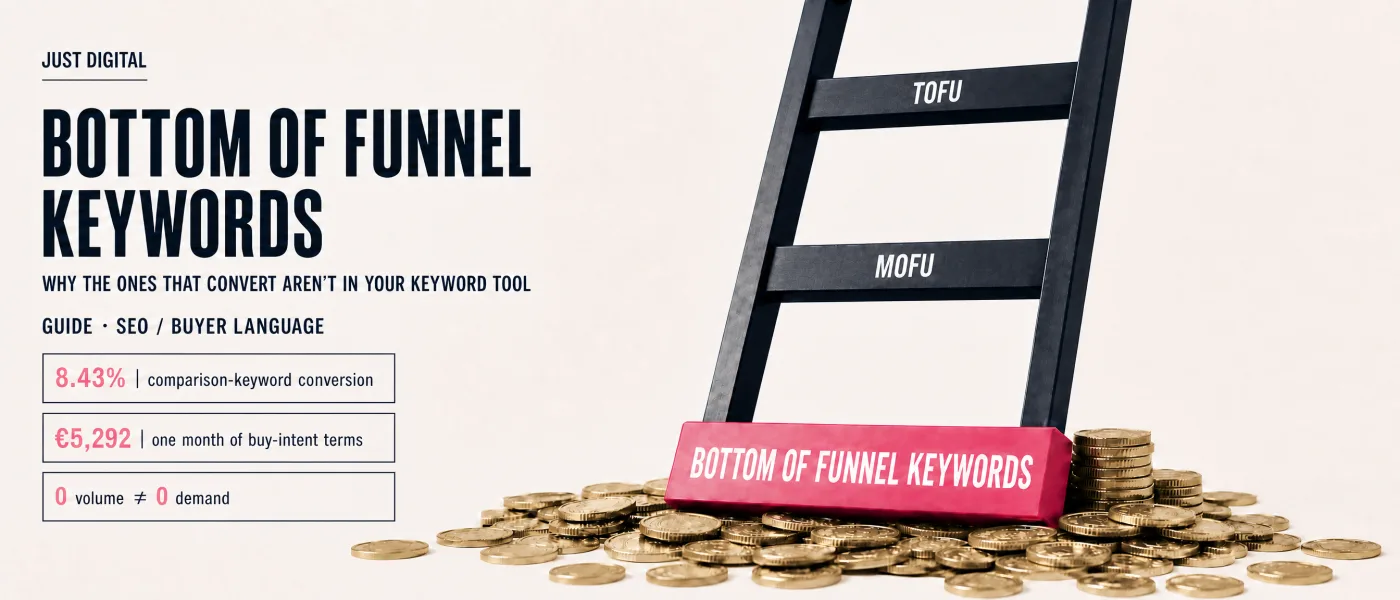
Jacob is a founder I work with. Sharp, runs a real business, pays for content. A while back he voice-dictated me his real questions while walking his dog, and one line came through as: "What's the difference between top, middle, and bottom-of-the-fold blogs?"
Bottom of the FOLD. Even the speech-to-text tool wanted to call it something else.
Further down the same list: "I paid four figures for a website that's not converting."
Funnel vocabulary is confusing enough to trip up a transcription app. It trips up plenty of humans too, and the second quote is what that confusion costs. If the terms are fuzzy, the content plans built on them don't stand a chance.
So this is the guide I wish someone had handed him. What bottom of funnel keywords actually are, the 6 types with examples, real Semrush numbers, receipts from my own client calls and my own Search Console, and a discovery method that starts in your reviews and inbox instead of a tool export. I publish data-led autopsies (the Justin Welsh case study is one), I lost my own six-figure site to Google in 2012, and every number here has a source. Several come from meetings I was in. The method comes from Sherlock, our Customer DNA report; more on that much later, after you have the whole method for free. You'll find the rest of the receipts in our other writing.
TL;DR
- Bottom of funnel keywords are the searches typed closest to the buying decision: pricing, comparison, alternative, review, and problem-verbatim queries.
- The label inverts the volume: "low funnel keywords" shows 1,000 searches a month while "bottom of funnel keywords" shows 70 (Semrush, US database, August 2026).
- Published client data puts comparison keywords at an 8.43% average conversion rate, against a roughly 0.10% SaaS purchase baseline.
- The highest-converting phrasings often show zero recorded volume. They come from buyer reviews, sales calls, and the support inbox, and Search Console proves the demand later.
- Sherlock, Just Digital's Customer DNA report, extracts that buyer language. Watson, the $9 copy diagnostic, is the entry, and the $9 includes one full Sherlock run.
What Are Bottom of Funnel Keywords?
Bottom of funnel keywords are search terms typed by someone close to a buying decision. Pricing queries, comparisons, alternatives, reviews, and the buyer's own problem sentence, typed straight into the search bar.
And to clear up Jacob's mix-up warmly, because it's common: the fold is a screen position (what you see before scrolling), the funnel is a buying journey. Most guides never anchor the funnel stages to what the searcher is actually doing, which is why the two blur together. Here's the anchor:
| Stage | What the Searcher Wants | Example Query | What to Build |
|---|---|---|---|
| TOFU (top) | To understand the topic | "what is a crm" | Educational guide |
| MOFU (middle) | To weigh approaches | "crm implementation checklist" | Framework, checklist |
| BOFU (bottom) | To choose and buy | "crm pricing for solo consultants" | Pricing, comparison, proof pages |
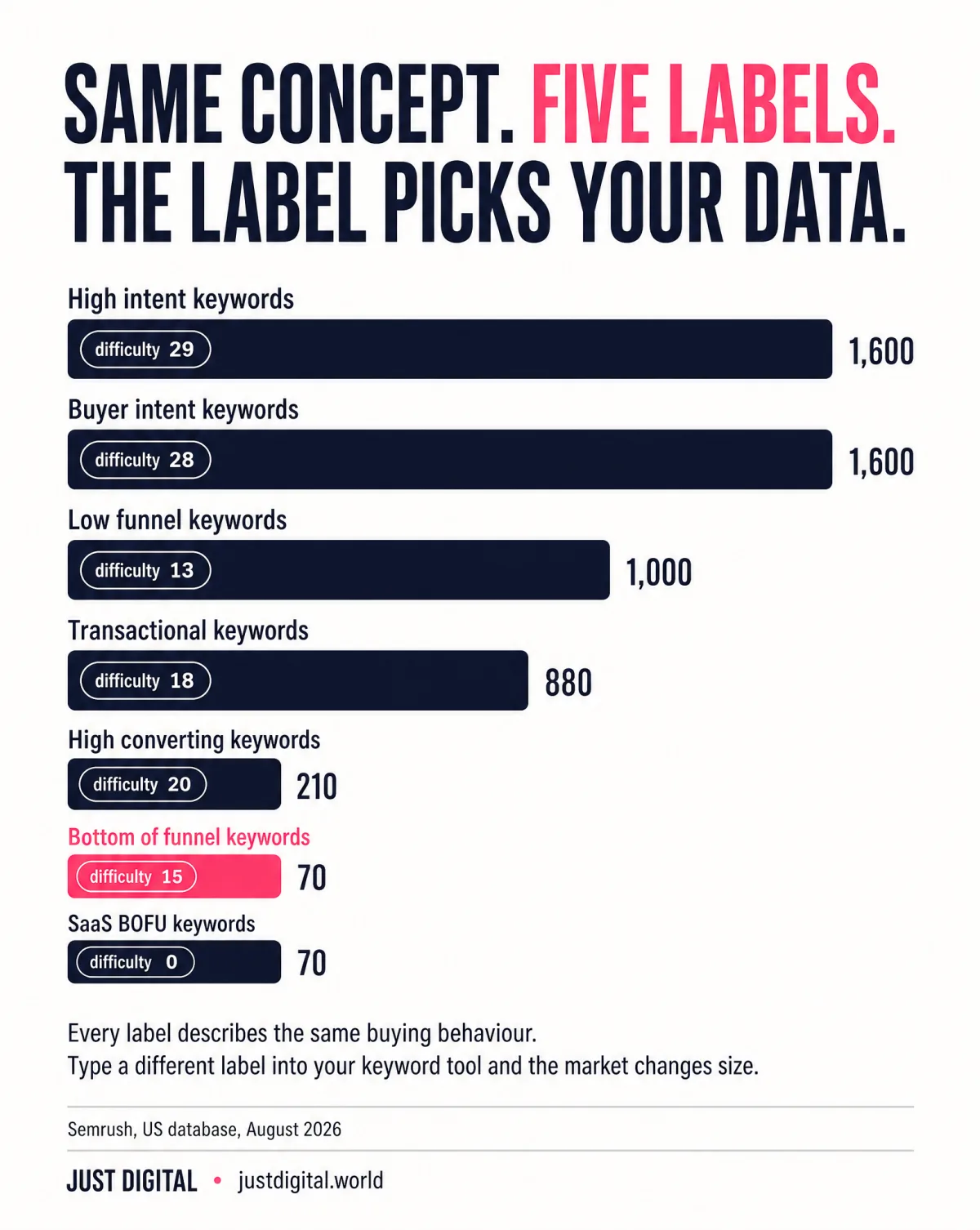
One more thing before the useful part. Is there a difference between "low funnel keywords" and "bottom of funnel keywords"? Behaviourally, none. Same searches, five-plus labels: low funnel, lower funnel, bofu, high intent, buyer intent, transactional. The label you type into a tool changes the data you see (1,000 searches a month for one label, 70 for another, same concept), which is its own small lesson about tools. This article says "BOFU keywords" for all of them. Search intent, not search volume, is what separates the stages.
Why Do Bottom of Funnel Keywords Convert When Nothing Else Does?
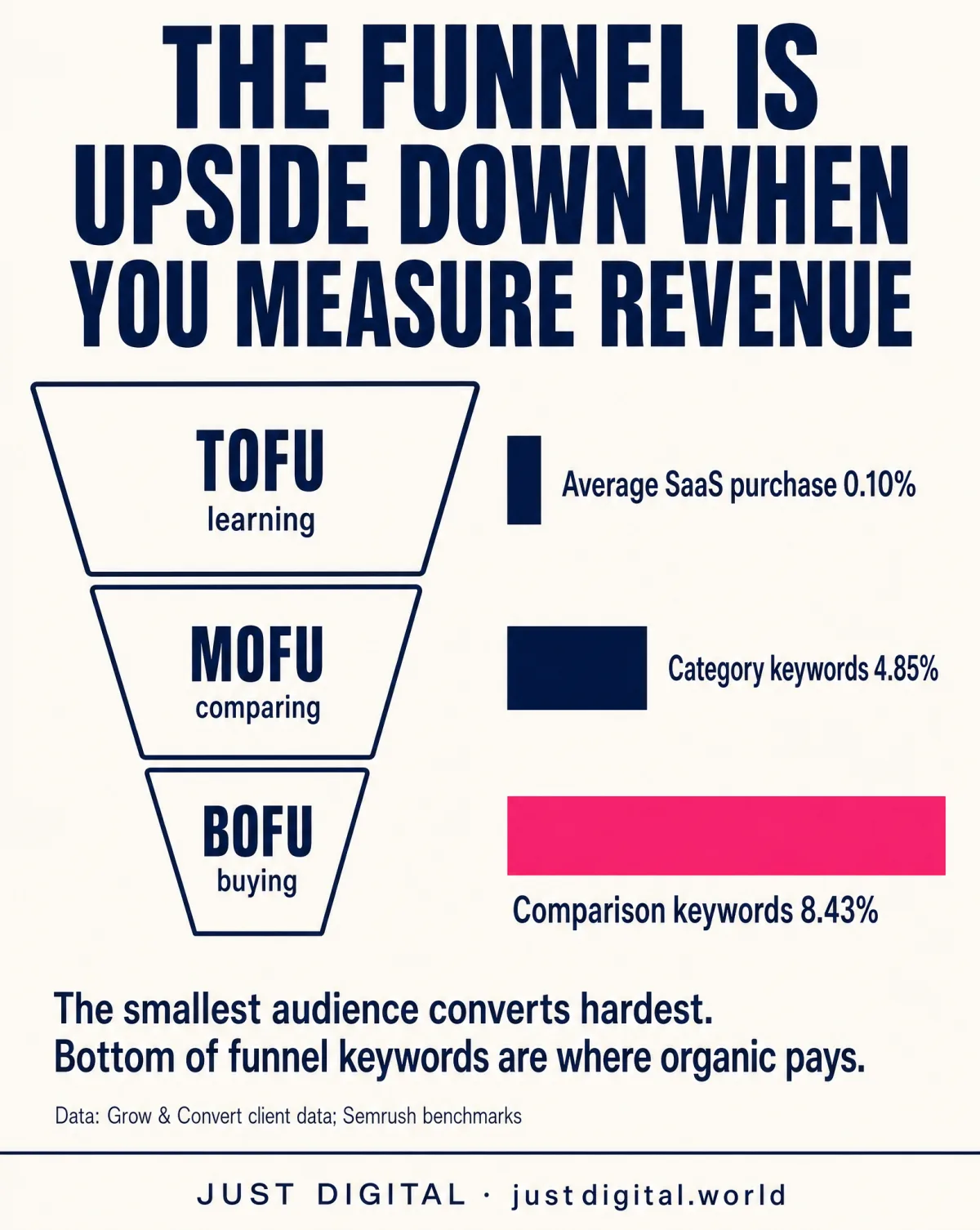
Comparison keywords convert at an 8.43% average in published client data (Grow & Convert). The average SaaS purchase conversion rate is about 0.10% (Semrush).
The mechanism is intent distance. A TOFU searcher is learning; a BOFU searcher is about to make a purchase. Most content marketing budgets chase organic traffic at the top of the funnel anyway, which is exactly why the bottom stays underpriced. The same page-building effort lands on wildly different revenue depending on which one you serve. Grow & Convert's published client data puts category keywords at a 4.85% average conversion rate and comparison keywords at 8.43%; in one case study the bottom-funnel posts converted 2400% better than the top-funnel ones (Grow & Convert). For scale: Semrush's lower-funnel benchmarks put average SaaS purchase conversion around 0.10% and ecommerce around 1.21% (Semrush).
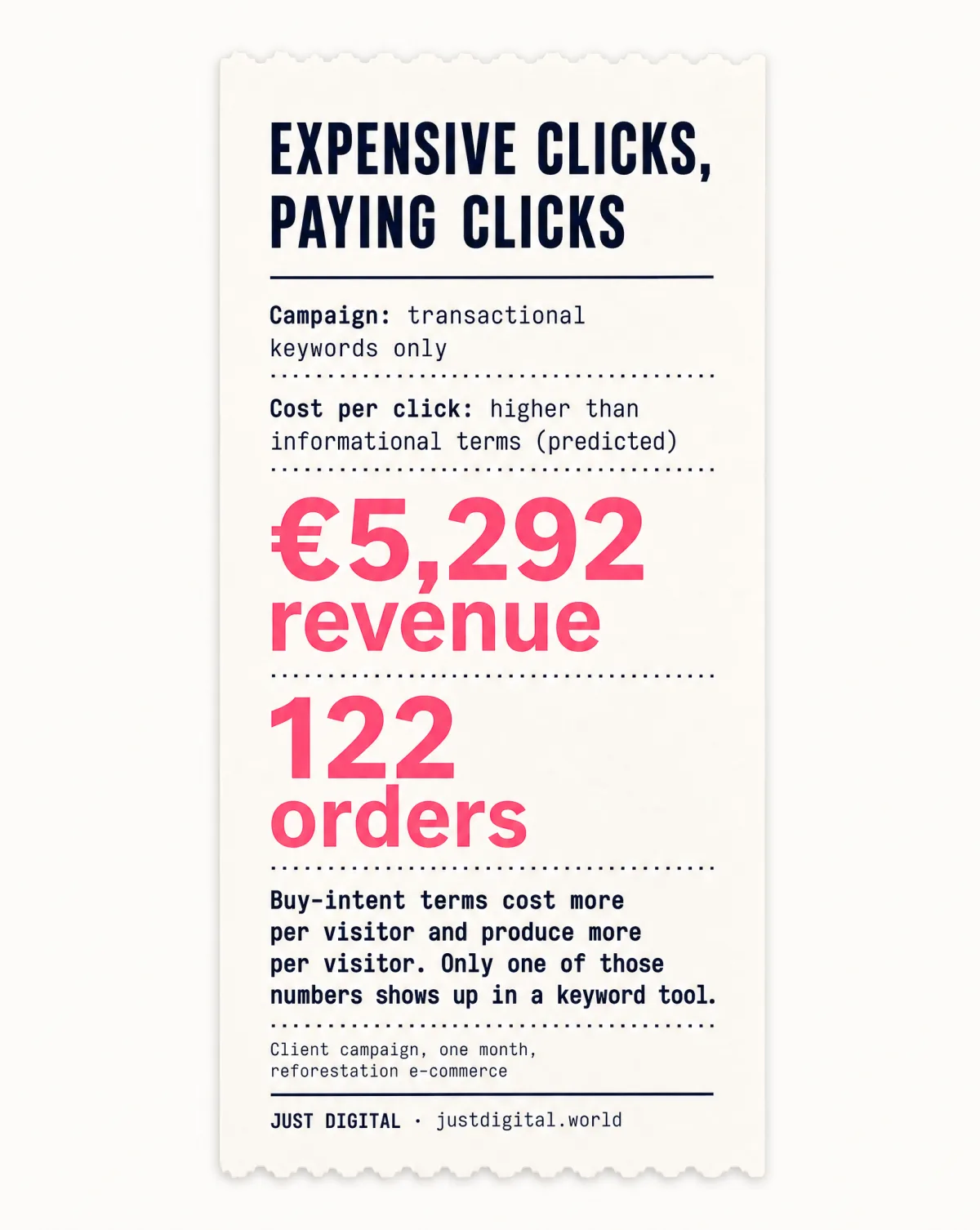
I ran this live with a reforestation client in Germany. We set up a campaign specifically on transactional keywords, the ones with obvious buy intent, and on the review call I told the founder: "the sales pages are finally producing revenue. They're still expensive per click, I predicted that, because these keywords carry high purchase intent, but they're the ones leading to the sales" (translated from German). That September the shop did €5,292 across 122 orders. On the same call I said the line I still stand by: "this is about making you money. Rankings and all that stuff are beside the point" (translated from German).
The numbers from that September, in one place:
| What We Did | What Happened |
|---|---|
| Ran a campaign on transactional, buy-intent keywords only | The ad groups with purchase intent were the ones producing orders |
| Paid more per click than informational terms cost | Predicted, and worth it: purchase-intent terms price in the buyer |
| Shop revenue that month | €5,292 |
| Orders | 122 |
Expensive clicks, paying clicks. Buy-intent terms cost more per visitor and produce more per visitor, and only one of those two numbers shows up in a keyword tool.
AI search sharpens all of this. A February 2026 Ahrefs study of 300,000 keywords found that when an AI Overview appears, the top result's average clickthrough rate falls by 58% (Ahrefs). Informational clicks are getting summarised away. Decision-stage clicks survive, because a buyer about to spend money still wants the pricing page, the proof, the exact answer. Visibility in AI answers matters; the click that buys matters more.
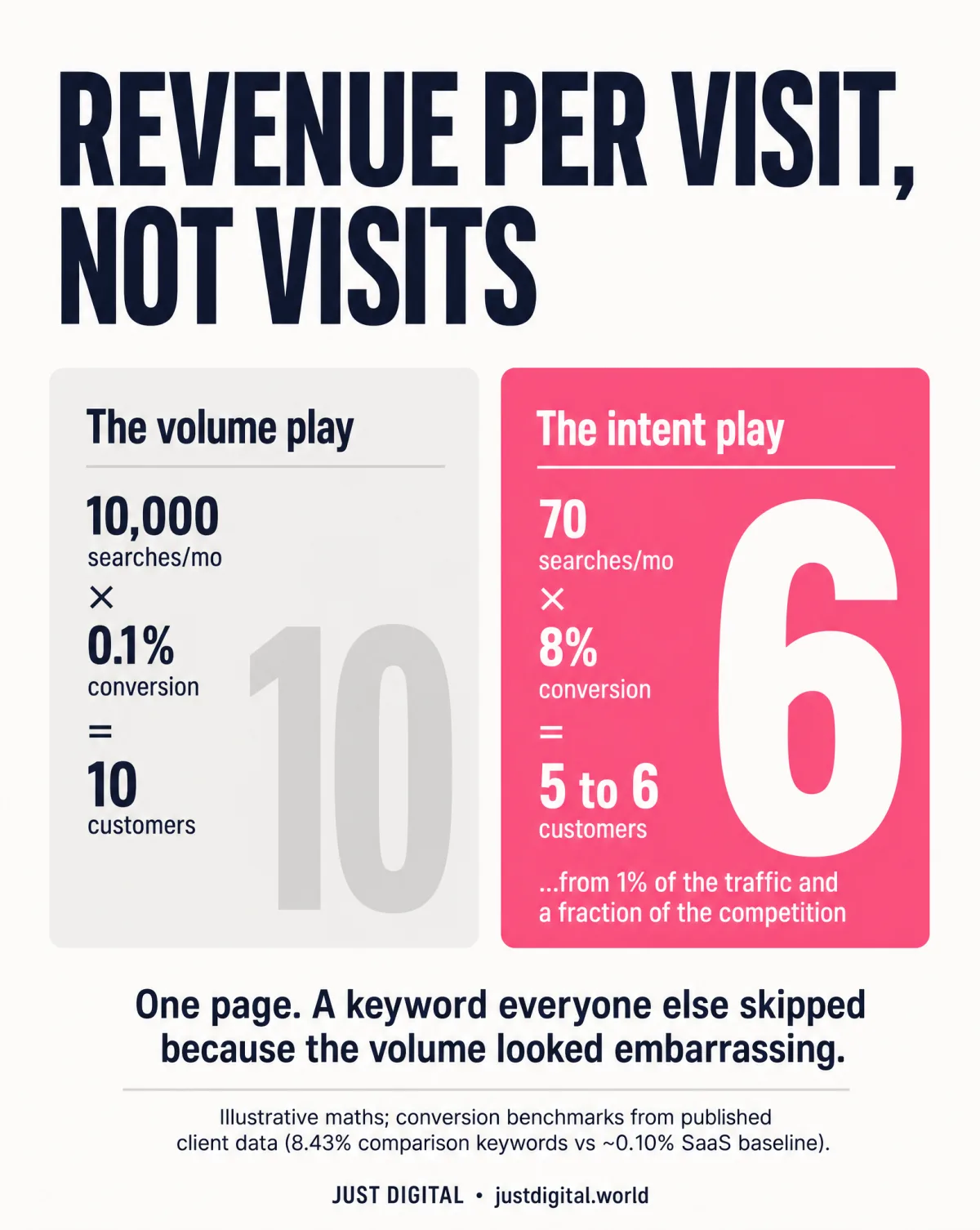
Which handles the tiny-volume objection directly. Are low volume keywords worth targeting? The unit of account is revenue per visit, not visits. A 70-search term converting at 5 to 8% can out-earn a 10,000-search term converting near zero. "Can", not "will": your offer and niche decide. But the maths runs in the small keyword's favour far more often than a volume-sorted export suggests.
What Do Bottom of Funnel Keywords Look Like? 6 Types With Examples
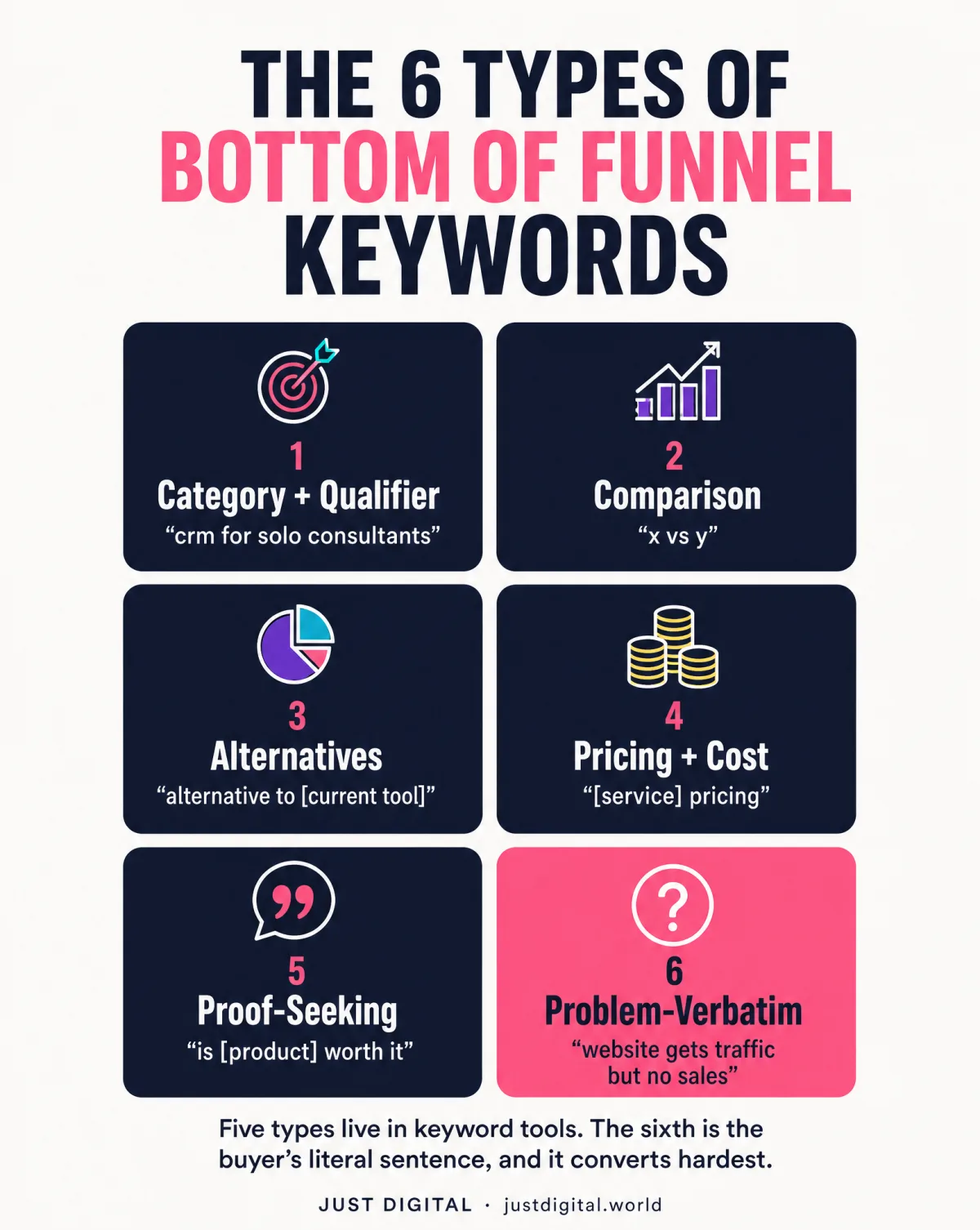
Five types live in keyword tools. The sixth, the buyer's literal sentence, never shows up in an export, and it converts hardest.
- Category + qualifier. The buyer names the category and their situation: "crm for solo consultants". The qualifier is the buying signal; it means they're shortlisting within a niche, not surveying a market.
- Comparison. The "x vs y" pattern. We don't name competitors on our own pages, and the pattern still works with categories: "done-for-you vs DIY buyer research". The buyer is choosing between two known options.
- Alternatives. "Alternative to [the tool they already use]." Someone typing this has already decided to switch. The page's job is to catch them mid-jump.
- Pricing and cost. "[Service] pricing", "how much does [service] cost", whatever the product or service. Budgeting is the last stop before buying. Sites that hide pricing hand this query to whoever doesn't.
- Proof-seeking. "[Product] reviews", "is [product] worth it". The buyer wants evidence before paying. Case studies with sourced numbers are built for exactly this search.
- Problem-verbatim. The buyer's literal sentence, typed into the search bar: "website gets traffic but no sales". No product named, pain fully named. No tool suggests these, because no tool heard the buyer say it.
What do these types look like on a real engagement? Here are the queries that produced actual shop revenue for a reforestation client in Germany. We found them by watching what converted in a small paid campaign, then built the organic pages to match:
| Query (Translated) | Type | Where It Came From |
|---|---|---|
| The organisation's own name | Proof-seeking (brand check) | Buyers verifying before paying |
| "gift trees" | Category + qualifier | The gift-intent ad group that converted |
| "tree planting campaign" | Category + qualifier | Campaign-intent buyers |
| "companies plant trees" | Category + qualifier (B2B) | Corporate gifting and CSR intent |
| "compensation certificates" | Problem-verbatim | A real prospect's own search, recalled by the founder's colleague in our kickoff |
Every row earned its place by converting, in ads or in a real prospect's behaviour, before we committed organic pages to it. A query that converts in ads or Search Console outranks any tool guess, and the roadmap stays open for exactly those late arrivals.
The reference version of each type, with the page it calls for:
| Type | Example Query | Buyer's Mental State | Page to Build |
|---|---|---|---|
| Category + qualifier | "crm for solo consultants" | Shortlisting within a niche | Use-case page |
| Comparison | "x vs y" pattern | Choosing between two known options | Comparison page |
| Alternatives | "alternative to [current tool]" | Ready to switch | Alternatives page |
| Pricing and cost | "[service] pricing" | Budgeting the decision | Transparent pricing page |
| Proof-seeking | "is [product] worth it" | Wants evidence before paying | Case study, receipts page |
| Problem-verbatim | "website gets traffic but no sales" | Feels the pain, hasn't named a product | Diagnosis-style post |
A word on modifier grids, since every guide hands you one: multiply your category by use case, industry, role, and business type, and you get a candidate list. It's a usable baseline and we use it too. But it's a starting grid, not the finish. The grid produces what everyone with the same tool produces. The types above, sourced from real buyers, produce what nobody else has.
Why Your Keyword Tool Can't See the Keywords That Convert
Keyword tools verify demand; they do not originate buyer language. The terms that convert enter the tool after a buyer says them, not before.
Start with the volume paradox, from the Semrush pull we ran for this article:
| Keyword | Searches/mo | Difficulty |
|---|---|---|
| high intent keywords | 1,600 | 29 |
| buyer intent keywords | 1,600 | 28 |
| low funnel keywords | 1,000 | 13 |
| transactional keywords | 880 | 18 |
| high converting keywords | 210 | 20 |
| bottom of funnel keywords | 70 | 15 |
| saas bofu keywords | 70 | 0 |
Semrush, US database, pulled 15 August 2026. The head term of this very article does 70 searches a month. We wrote it anyway. The table is why: the demand for the concept is scattered across labels, and the pages that win these SERPs win buyers, not browsers. (One of those labels earned its own investigation: high converting keywords covers how to prove which terms convert for YOU, with your own Search Console and GA4.)
Why do tools under-index the phrasings that convert? Because tools aggregate tracked, repeated search queries. A buyer's literal sentence is long, singular, and often typed a handful of times a month in your niche. Volume-sorted exports bury those by design; the export can't show you what it was never built to count.
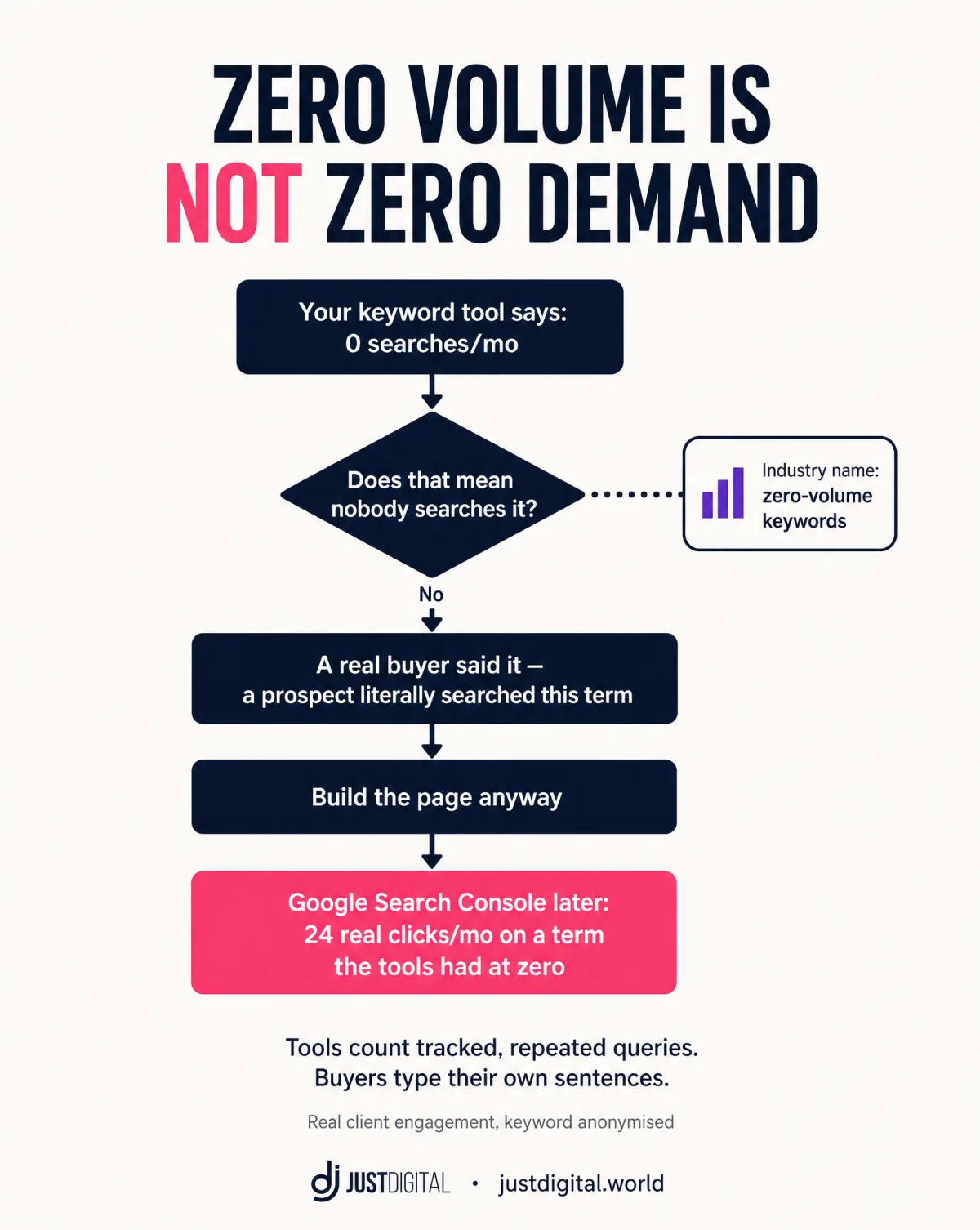
I watched this play out in a kickoff meeting with a reforestation client in Germany. The founder had invented a keyword for a guide he wanted, a nice-sounding compound word, and asked me to check whether anyone searched it. I typed it into the tools: nothing. So I taught him the rule on the spot: "it has no volume. That does not mean people aren't searching for it. There's even an industry term for this: zero-volume search terms. The tools everyone uses say zero, but the searches are real, and you can prove it later through Google Search Console. Sometimes the tools say a term gets three clicks a month, or zero, and in reality 24 happen" (translated from German). That 24 was not hypothetical: Search Console later showed 24 clicks on a donation keyword the tools had at zero.
And in the same meeting, the founder's colleague mentioned where their strongest keyword idea had actually come from: "that one came from practice, a prospect of ours searched exactly that" (translated from German). Not a brainstorm. Not an export. A real buyer's real search.
Google's own guidance points the same direction, from the other side: its helpful-content documentation warns against "producing lots of content on many different topics in hopes that some of it might perform well in search results" (Google Search Central). Chasing the export is exactly that, at scale.
So what are tools for? Verification. Once a phrase is sourced from a buyer, keyword research does its real job: the tool checks search volume, difficulty, and SERP shape. Tool choice affects what you see; buyer language determines what you can say. The search engine mechanics that come after, titles, structure, internal links, schema, are a different article, and we've already written it: 50 search optimization tips.
How Do You Mine Bottom of Funnel Keywords From Your Buyers' Own Words?
Your buyers have already written your keyword list. It is sitting in your reviews, your sales calls, and your inbox, waiting to be extracted.
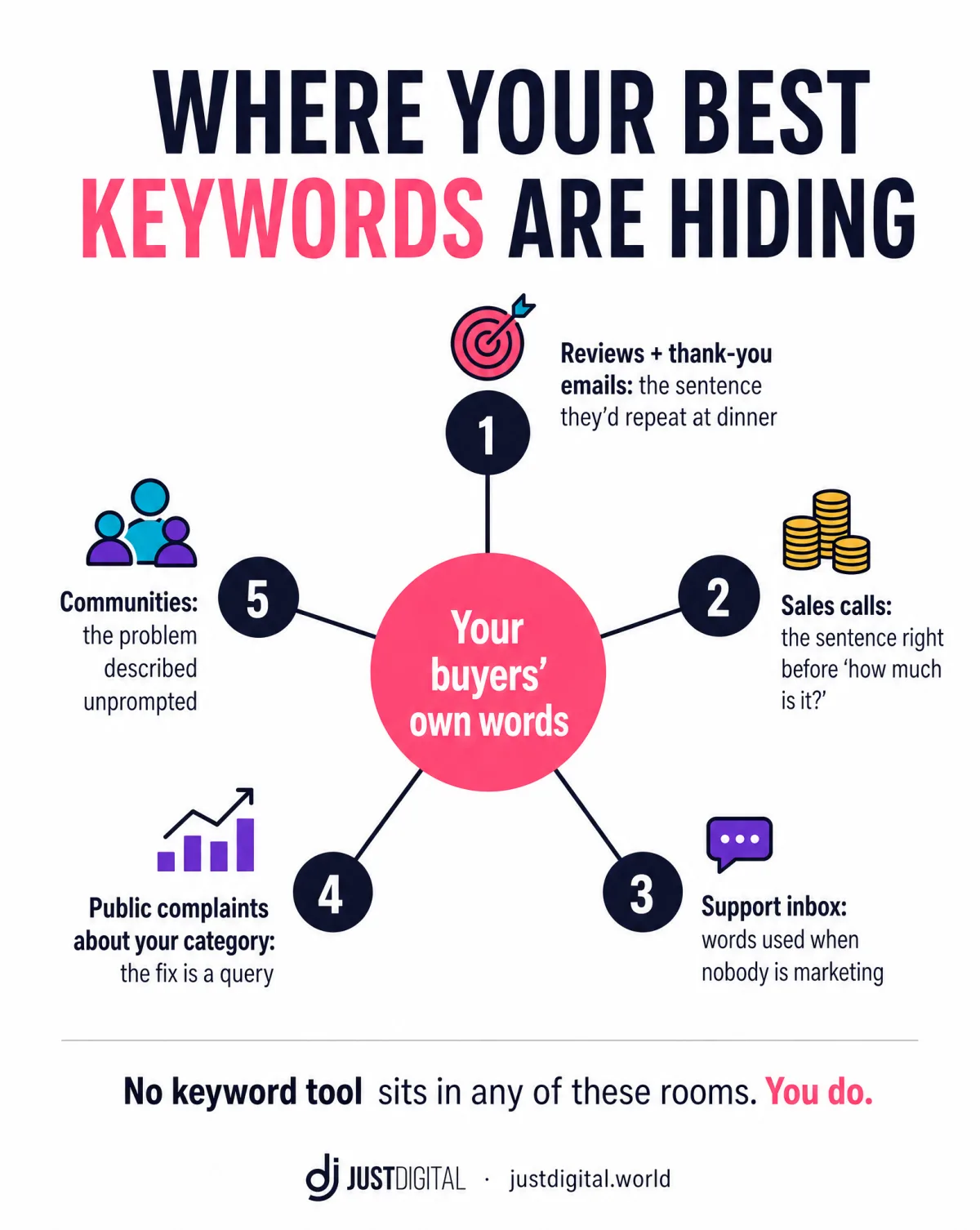
Our published method is four words: Listen, Prove, Write, Measure. The Listen step has 5 sources, and each one has a specific thing to listen for:
- Your reviews and thank-you emails. Listen for the sentence a customer would repeat at dinner: "it finally told me why nobody was buying." That sentence, shortened, is a query.
- Sales-call recordings. Listen for the sentence immediately before "how much is it?". Whatever the prospect said right before asking the price is the thought that made them ready.
- Support and pre-sales inbox threads. The words people use when nobody is marketing at them. Rawest source you own.
- Public complaint patterns about your category. Patterns, not names, on our pages. What do people say the category keeps getting wrong? Their complaint is a query with the fix implied.
- Communities where buyers describe the problem unprompted. Forums, groups, subreddits. The phrasing there predates any marketer's involvement, which is exactly its value.
The reforestation client's strongest keyword came from source 2: a real prospect's search, remembered by the founder's colleague. That's how it usually goes. The strongest keyword walks in through a conversation, not an export.
Extraction looks like this in practice:
| What the Buyer Said | Candidate Keyword | Page to Build |
|---|---|---|
| "We kept paying for clicks that never bought" | "roi of [service]" | Proof-seeking case study |
| "It reads fine. Fine gets scrolled past." | "why is my landing page not converting" | Diagnosis-style post |
| "We couldn't tell which tool actually told us why" | "[category] tools that show why visitors don't buy" | Category + qualifier page |
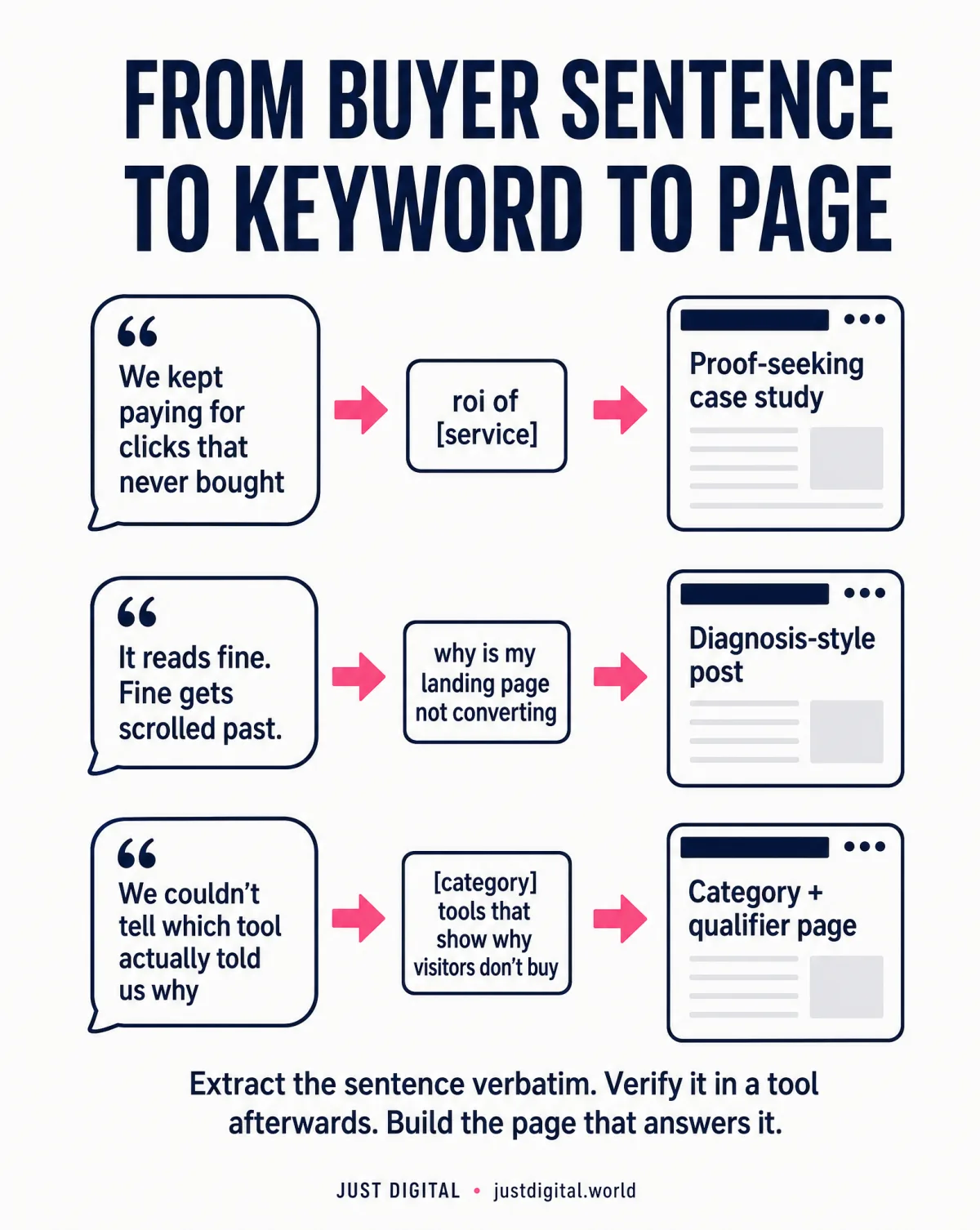
Then the verification loop: take each phrase to your keyword research tool of choice, check search volume, difficulty, and what the SERP currently rewards, and make the page decision. One rule from the kickoff story above: zero volume with a documented buyer quote behind it is a green light, not a red one.
That's the whole mining method.
Want the Buyer-Words List Without the 40 Hours? Run Sherlock
How We Write a Strategy That Produces BOFU Keywords
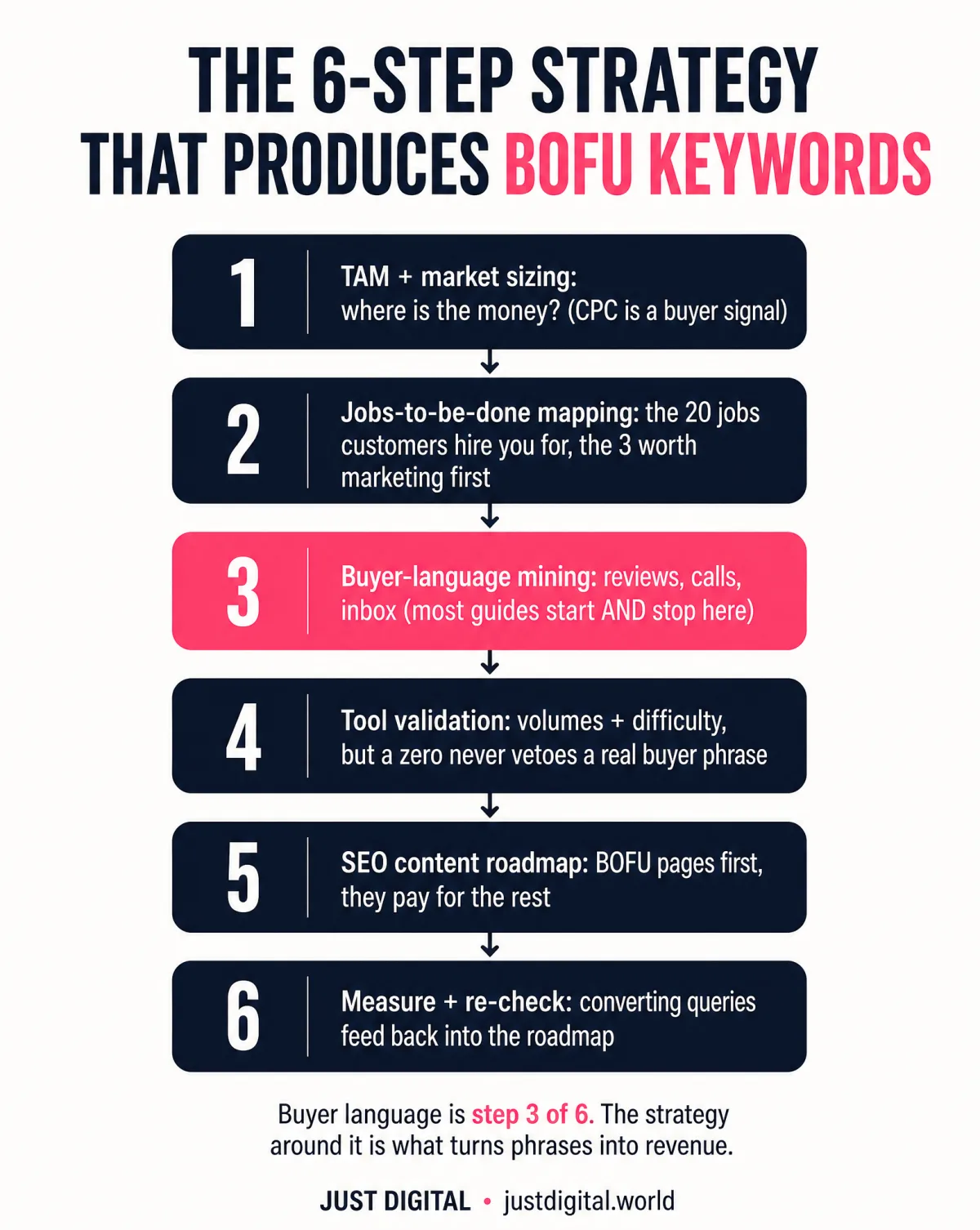
One correction before the method, because the shortcut reading of this article would be "mine some reviews, done." Buyer language is not a trick, it is step 3 of 6. On real engagements it sits inside a strategy, and the strategy is what turns phrases into revenue instead of rankings. That is the difference between a keyword list and an SEO strategy. Here is the exact order we run:
- TAM and market sizing. Before any keyword gets picked, size where the money is: which segments search, what a click costs, what a customer is worth. Cost per click is a buyer signal in itself; advertisers don't pay $39 a click for browsers.
- The JTBD Application Mapper. Find the 20 jobs customers hire you for, and the 3 worth marketing first. This prompt is the most important asset in the whole method, because every keyword downstream hangs off a job somebody is trying to get done. The excerpt is below; the full prompt is free.
- Buyer-language mining. The 5-source process from the previous section: reviews, calls, inbox. On engagements, this is Sherlock's job. The Customer DNA report does the 40 hours of listening.
- Keyword-research validation. Run the candidate terms through DataForSEO or Semrush for volumes, difficulty, and SERP shape. One caveat, learned live in that client kickoff: a zero in the tool does not mean no demand. Validate, but never let the tool veto a documented buyer phrase.
- The SEO content roadmap. Decide which pages get built and in what order. BOFU first, because those pages pay for the rest. On engagements this step's output is the Organic Growth Opportunity report (next section).
- Measure and re-check. Watch Search Console and analytics for what actually converts, then feed converting queries back into the roadmap. The roadmap is living: a query that converts in ads or Search Console outranks any tool guess.
About step 2. The JTBD Application Mapper works for any business: local services, SaaS, agencies, consultants, e-commerce, B2B products. You paste it into ChatGPT, Claude, or Gemini with just 2 inputs, and it maps the jobs your customers hire you for before a single keyword gets discussed. Here's the opening:
The JTBD Application Mapper Find the 20 jobs customers hire you for, and the 3 worth marketing first.
INPUT 1: Describe the business (what you sell, to whom, at what price). INPUT 2: List your target segments.
STEP 1: Understand the offer. Before generating anything, restate what this business actually does, who pays for it, and what changes for the customer after buying. [... the full prompt continues through Step 2, 20 jobs to be done per segment, and the narrowing steps ...]
The full prompt is free. It arrives with the newsletter welcome email:
How Do Sherlock and the Organic Growth Opportunity Report Turn Buyer Language Into Ranked Pages?
In 2022 and 2023 I would spend 30 to 40 hours per client interviewing the sales, support, and success teams, just to extract what they'd heard customers say. The answers were always in there. The hours were the problem, and most businesses never spend them. That's what our two research products exist for, and they map onto the method directly: Sherlock does steps 2 and 3, the listening; the Organic Growth Opportunity report does steps 1, 4, and 5, the money map.
Sherlock is the Customer DNA report (Sherlock): it builds the full psychological profile of your real buyers from their own words. You get a 40 to 90 page formatted report: buyer psychology mapping (dreams, objections, fears, frustrations), an "exact words" section of buyer language ready to paste, objection response scripts, a visual priority map with a 90-day action plan, and channel guidance for website, email, LinkedIn, and ads. For this article's thesis, the important part is the exact-words section: that IS the BOFU seed list, and the objection map names the decision-stage pages worth building. Current package details are on the product page. To see what that language does inside a live campaign, read the message testing case study: same buyer words, ads channel, cost per conversion down 49.3%.
The Organic Growth Opportunity report is the money map. We built one recently for a sales-training founder, and it shows which keywords have the money: keyword-opportunity tables (real terms with volumes and cost per click, sorted by commercial value), funnel-demand mapping (where the search demand sits: top, middle, bottom), who owns the space today, and revenue projections (what the traffic could look like and what it could be worth), ending in a build order for the first pages. The signature logic in one line: a $39 cost per click on a booking-intent term signals buyers actively ready to buy; those are the most commercially valuable searches in a market.
And the entry: Watson, the $9 one-time copy diagnostic (Watson). No subscription. It investigates your homepage, scores seven buying triggers, and ranks the leaks costing you sales. The report is in your hands in about 10 minutes and reads in about 10 minutes. It runs inside Claude; setup takes about two minutes with the included guide, no technical skill needed. The $9 also includes one full run of every other detective in the agency: Sherlock (Customer DNA), Moriarty (competitor teardown), Virtual Dom (marketing coach), and Google Quality Rater (SEO check). Lestrade, the intake interviewer, stays free and unlimited.
The terms, in the exact words we publish them: "Try it without risk. Run all 5 tools once each. If you don't find a single thing worth changing in your marketing, reply to your receipt and get the $9 back."
Vanjo, founder of Wolkk, after his run: "It described our buyers better than we could ourselves."
What these will NOT do: they don't write your pages, run A/B tests, or promise rankings. They put real buyer language and a money-ranked keyword map in your hands; the building is still building. And disclosed plainly: Watson, Sherlock, and the Organic Growth Opportunity report are Just Digital's own products. That is exactly why this article can show you the whole method for free.
The $9 Watson run includes one full Sherlock pass: the buyer-language extraction this whole article is about, for the price of a sandwich.
What Should You Build With Bottom of Funnel Keywords Once You Have Them?
Match the page to the query type, and don't get clever:
- Category + qualifier gets a use-case landing page that names the situation in the H1.
- Pricing queries get a transparent pricing page. If you can't print prices, print ranges and what moves them.
- Proof-seeking queries get a case study with sourced numbers, built the way you'd want to be convinced.
- Problem-verbatim queries get a diagnosis-style post that names the pain in the buyer's words, then walks the fix.
Now a word of caution. Scaling generic definition content is the opposite play, and I documented what happened to it: justinwelsh.me grew organic search traffic about 480 times between 2021 and 2025, then lost roughly 94% of it in six months after the December 2025 and March 2026 core updates (about 8,685 visits in December 2025 down to 740 in June 2026, per Semrush). Read the full Justin Welsh autopsy or the short version. What got hit was a thin programmatic glossary: definition pages at scale, the exact thing a volume-sorted export tells you to build.
Scaled definition content has a published failure receipt: about 480x up, then roughly 94% gone in six months.
It was the pattern, not an outlier. SE Ranking's April 2026 analysis of 100,000 keywords found the March 2026 core update changed 79.5% of Top-3 positions and dropped 24.1% of Top-10 pages out of the Top 100 entirely (SE Ranking).
Bottom of funnel content earns its keep in revenue, not readership. So the standing rule I run every engagement on: don't scale generic definitions, scale bottom-funnel buyer-centric terms instead, and always redirect to an owned list. Every BOFU page routes attention to an email list you own. Rented traffic gets recalled. Owned audience compounds.
Which Bottom of Funnel Keywords Should You Target First?
Prioritise by evidence: a documented buyer quote first, then lowest difficulty, then volume last.
A bigger search volume number never beats a phrase you can trace to a real buyer, because volume counts the people searching, not the people ready to buy. A low funnel keyword with 20 searches and clear decision intent beats a head term with thousands. After the quote test, sort what's left by difficulty and clarity of decision intent. And the ideal first bottom of funnel keyword looks like this, from the Semrush table above: "saas bofu keywords", 70 searches a month at difficulty 0. Real demand, no competition. Terms like that hide in every niche, precisely because volume-sorted thinking filters them out.
Here is exactly what I tell founders who want to test this without betting the quarter: you find a keyword that has volume, has purchase intent, and you have something to offer against it. The easiest way to quick revenue is: choose one keyword, create the page, put the keyword in the URL. One keyword. One page. Then watch what it does in Search Console. That is the whole test.
For the first 90 days, this build order:
- 1 transparent pricing page. The highest-intent query you can own.
- 1 proof-seeking case study. With sourced numbers, not adjectives.
- 2 problem-verbatim posts. Straight from your inbox's most repeated pain sentences.
- 1 category + qualifier page. Your category, your buyer's situation, in the H1.
- Re-check after each core update before adding more. A fix nobody re-checks is a guess.
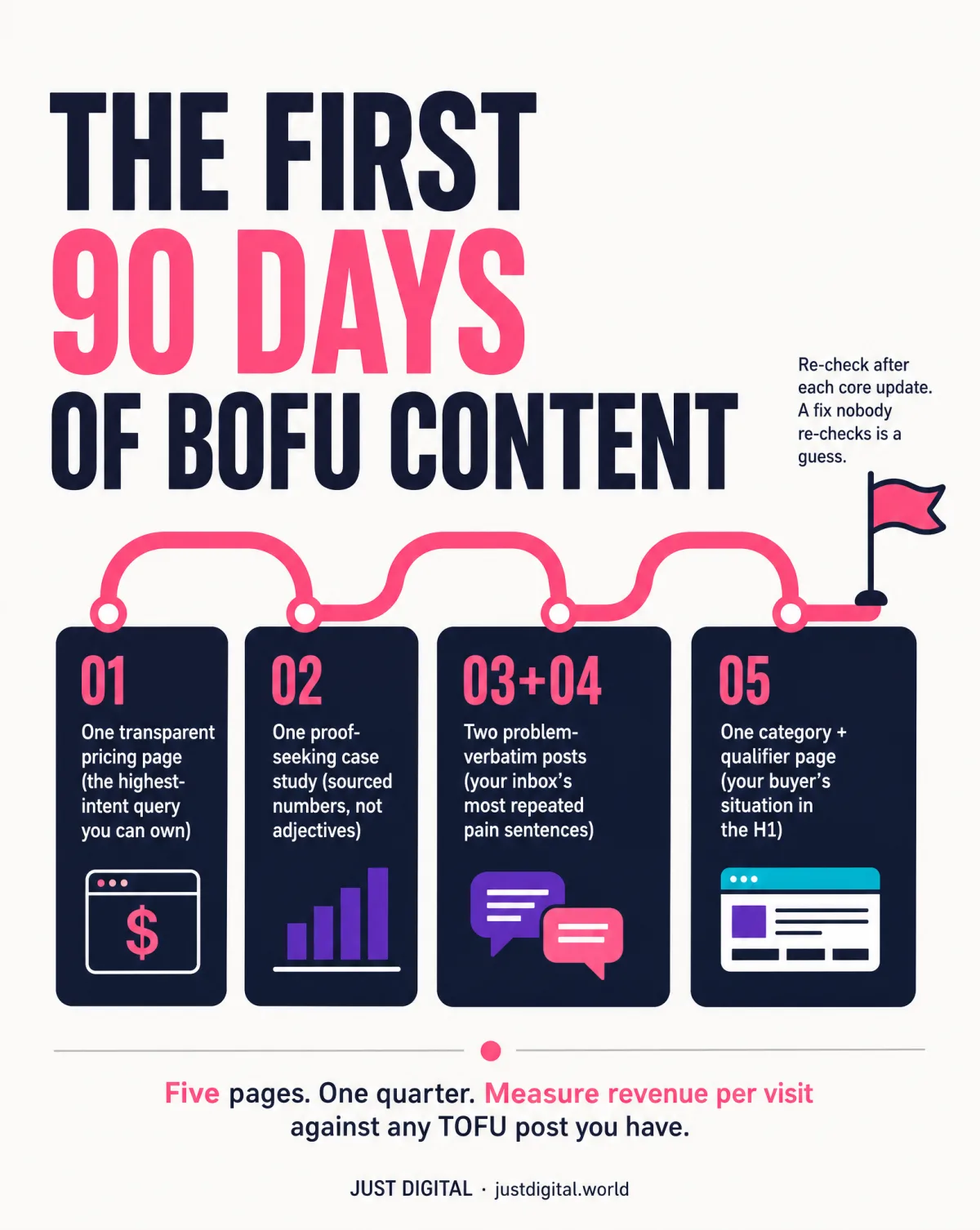
If the calendar is already full of TOFU commitments, don't fight the calendar. Swap one slot. One BOFU page, one quarter, measure revenue per visit against any TOFU post you've published. Present the delta. The data makes the argument so you don't have to.
Ready to Check Whether Your Ranked Pages Convert? Start With Watson
Conclusion: The Tool Confirms, the Buyer Supplies
Three beats. BOFU keywords are decision-stage sentences, not volume plays. Your buyers already say them, in reviews, calls, and your inbox. Tools verify what buyers supply, never the other way round.
That's the discipline Just Digital runs on: proof first, in your buyer's own words. Run Watson at getwatson.io, $9 one time, and the $9 includes one full Sherlock run.
Want case studies like this one, plus the full JTBD Application Mapper prompt in the welcome email? Subscribe right here:
Frequently Asked Questions
How Do You Choose Keywords for Bottom of Funnel Pages?
Start from evidence, not volume.
- Pull phrases your buyers actually said: reviews, calls, inbox.
- Verify each phrase in a keyword tool (DataForSEO, Semrush) for difficulty and SERP shape.
- Prefer a documented buyer quote over a bigger volume number.
Note: zero recorded volume with a real buyer quote behind it is a green light, not a red one. Search Console proves the demand after the page exists. See the 6-step strategy above.
What Is the Difference Between TOFU, MOFU, and BOFU Keywords?
Three stages of the same search journey.
- TOFU: learning the topic ("what is a crm").
- MOFU: weighing approaches ("crm implementation checklist").
- BOFU: choosing a solution ("crm pricing for solo consultants").
However: the labels matter less than the behaviour. This guide treats every decision-stage query as BOFU. The funnel-stage table above anchors all three.
Are Low Volume Keywords Worth Targeting?
Often, yes.
- Decision-stage terms cluster at low and zero volume.
- Published client data shows comparison keywords converting at 8.43% on average.
- In one client campaign, the buy-intent ad groups were the ones producing orders: €5,292 across 122 orders in a single month.
Note: verify the SERP shape first. Low volume with an irrelevant SERP is just an unsearched term.
Do Bottom of Funnel Keywords Work for SaaS?
Yes, and the data is unusually friendly.
- "saas bofu keywords" itself shows 70 searches a month at difficulty 0 (Semrush, US database, August 2026).
- Pricing, alternative, and "for [role]" queries are where SaaS buyers finish deciding.
- Average SaaS purchase conversion is about 0.10%, so a 5%-converting BOFU page is a different business.
However: SaaS buyers read proof-seeking pages hardest. Receipts beat adjectives.
What If I Have No Reviews or Sales Calls to Mine Yet?
You still have sources.
- Run Lestrade, Just Digital's free, unlimited intake interviewer, to structure what you already know.
- Run the JTBD Application Mapper to generate the 20 jobs customers would hire you for.
- Mine public communities where your buyers describe the problem, and interview your first 3 users.
Note: Lestrade stays free and unlimited. It is the entry point of the detective agency.
Is Sherlock a Subscription, and What Exactly Do I Get?
No subscription. Sherlock is the Customer DNA report (getsherlock.io).
- A 40 to 90 page formatted report on your real buyers.
- Buyer psychology mapping: dreams, objections, fears, frustrations.
- An "exact words" section of buyer language ready to paste, plus a 90-day priority map.
Note: current package details and pricing are on the product page.
What Does Watson Check That Analytics Don't Show?
Analytics show where visitors drop. Watson reads why.
- $9 one time, no subscription.
- It scores seven buying triggers on your page and ranks the leaks costing you sales.
- Report in your hands in about 10 minutes; runs inside Claude, about 2 minutes of setup.
However: the terms are exact: "Try it without risk. Run all 5 tools once each. If you don't find a single thing worth changing in your marketing, reply to your receipt and get the $9 back." Run Watson at getwatson.io.
How Many Bottom of Funnel Pages Does a Small Site Need?
Fewer than you think.
- Start with 5 in 90 days: 1 pricing, 1 proof, 2 problem-verbatim, 1 category page.
- One well-matched BOFU page can outperform a year of definitional posts.
- Re-check rankings after each core update before adding more.
Note: the $9 Watson run includes one full Sherlock pass, which typically maps the first 5 pages on its own.
How Do I Get the Full JTBD Application Mapper Prompt?
It is free, and it arrives by email.
- Subscribe to the newsletter using the form under the excerpt.
- The welcome email carries the link to the full prompt.
- Paste it into ChatGPT, Claude, or Gemini with your business description and target segments.
Note: the prompt finds the 20 jobs customers hire you for, then narrows to the 3 worth marketing first. It works for any business.
Sources
- Grow & Convert: Bottom of the Funnel Keywords (published client conversion data, updated October 2025)
- Semrush: 9 Lower-Funnel Marketing Tactics to Boost Sales (17 October 2025)
- Ahrefs: AI Overviews Reduce Clicks (300,000 keywords, 4 February 2026)
- Google Search Central: Creating Helpful, Reliable, People-First Content
- SE Ranking: March 2026 vs December 2025 Core Update Volatility (100,000 keywords, 17 April 2026)
- Semrush keyword data, US database, pulled 15 August 2026 (first-party)
- Client meeting transcripts and recorded working sessions, 2024 to 2026 (first-party; quotes translated and anonymised)
- Google Search Console, 16-month pulls from our own properties, 15 August 2026 (first-party)