Website Copy Audit: How to Find the Line That Loses the Sale
Website copy audit method: 3 audit layers, 7 diagnostic questions, 5-step self-audit walkthrough, before/after hero rewrite table, cost comparison (free self-audit, $9 Watson diagnostic, $1,000-$5,000 professional audits), and FAQ covering audit frequency, AI copy checks, and free options.
You wrote the homepage with AI. Then you rewrote it. Twice. It reads fine, your mates say it reads fine, and the sales still aren't coming. Analytics can show you where visitors leave. It has never once told you why.
It reads fine. Fine gets scrolled past.
A website copy audit is what you run when the page reads fine but doesn't sell: a structured review of the words on the page to find what stops a reader buying. It leaves the grammar and the design alone and goes looking for the line that loses the sale.
This guide gives you the three things the search results for this term keep behind a discovery call: the complete self-audit method, a worked before/after on a hero section, and the actual prices at every level. The method is packaged in Watson, the $9 one-time copy diagnostic: it reads your page the way your buyer's brain does, scores 7 buying triggers, ranks the leaks, and names the first fix, with the report in your hands in about 10 minutes.
TLDR: What Should You Know About a Website Copy Audit?
- A website copy audit reviews the words on a page to find what stops a reader buying. It examines the headline promise, offer clarity, proof, objection handling and calls to action. It is not a website audit, which covers site-wide technical health, SEO and UX.
- A complete audit has 3 layers: proofreading (grammar checkers do this), conversion diagnosis (Watson scores 7 psychological buying triggers, ranks the leaks, names the first fix, $9 one time, report in about 10 minutes), and the evidence audit (do the words match what real buyers say; Sherlock's Customer DNA layer).
- Costs, printed: the self-audit in this guide is free and takes an afternoon. Watson is $9 one time, no subscription. Professional website content audits run $1,000 to $5,000 per current rate roundups.
- Order matters: audit before you spend on traffic. At small-site traffic an A/B test can't referee copy; a diagnosis of the page as written can.
What Is a Website Copy Audit?
A website copy audit is a structured review of the words on a page to find what stops a reader buying. Copywriters also call it a copy critique or a focused review of your web copy; the name matters less than the output, which should be actionable: a short list of leaks, ranked, with a fix for each. That's the whole job.
The term gets conflated with two neighbours, so here's the boundary. A website audit reviews the whole site: crawlability, speed, structure, user experience. An SEO audit lives on that side too; search engine optimization problems explain missing traffic, not visitors who leave without buying. A website copy audit stays on the message: the value proposition, proof, objections, calls to action, and whether the core message lands with your target audience. This guide covers the copy layer; the wider cro audit covers the full conversion picture around it.
The other neighbour is software. A website copy checker (or copywriting checker) verifies the writing is correct: grammar, spelling, tone, sometimes brand voice consistency. Useful, and not an audit. Correct copy can still lose every sale, because correctness was never the reason anyone bought. The audit judges whether your existing website copy sells; the checker judges whether it's spelled right.
| Review type | What it examines | What it catches | Typical output |
|---|---|---|---|
| Website copy checker | Grammar, spelling, tone | Correctness errors | Inline corrections |
| Website copy audit | The message: promise, proof, objections, CTA | The line losing the sale | Ranked leaks and fixes |
| Website audit | Site-wide tech, SEO, UX | Crawl, speed, structure issues | Technical report |
So when your page "reads fine" and doesn't convert, a checker has nothing left to tell you. An audit does.
Why Does Copy That Reads Fine Still Not Sell?
Because AI drafting optimises fluency, and fluency is not persuasion. A model's job is to produce text that reads well. It does that job every time, which is why every draft you generate reads fine, and why reading fine tells you nothing about whether the page sells.
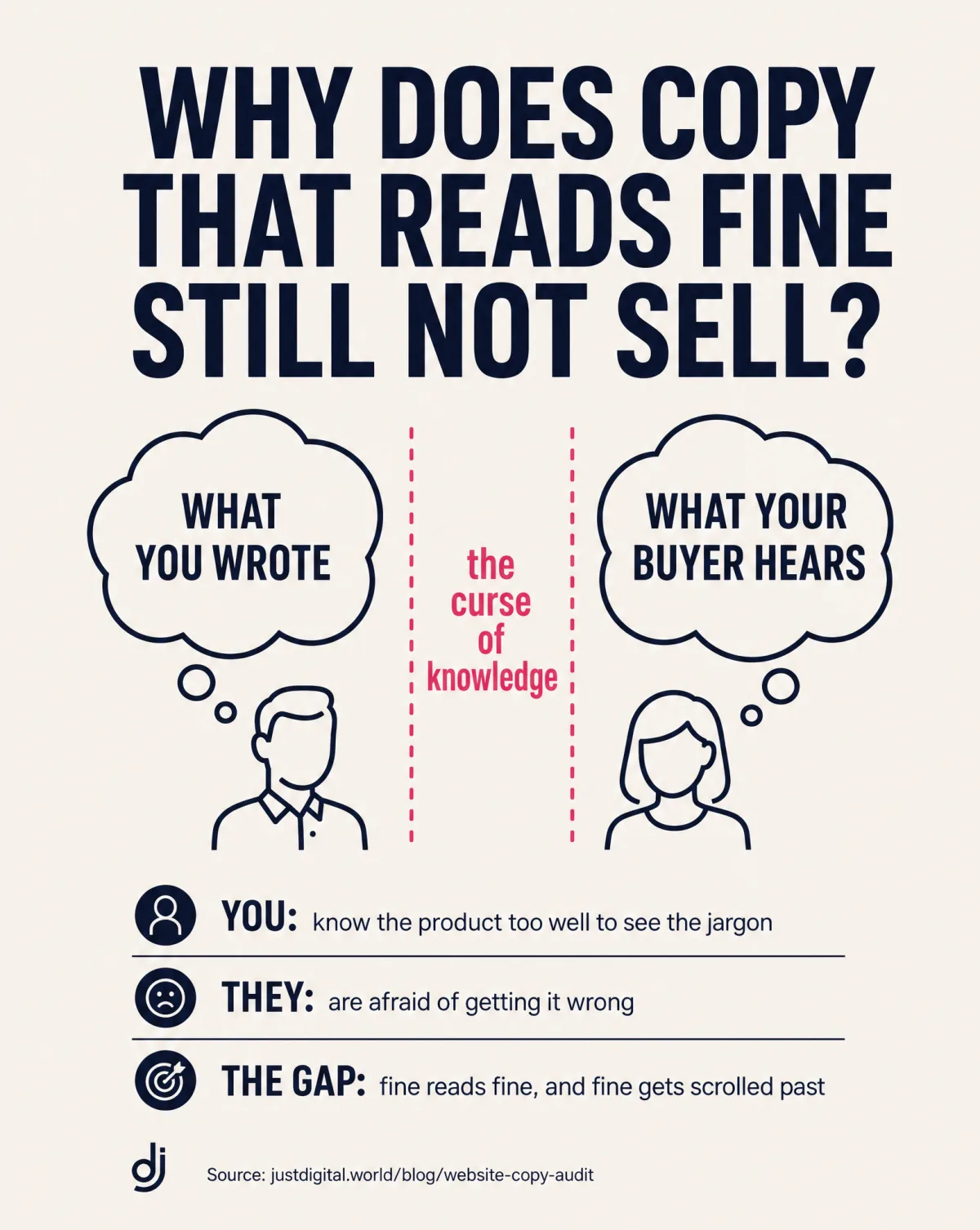
The research on this is older than the tools. In five experiments at Princeton and Stanford, psychologist Daniel Oppenheimer found that needlessly complex wording made authors seem less intelligent, not more. 86.4% of the students polled admitted complicating their writing to sound smarter. Readers punished them for it. Polish points the wrong way: the reader rewards being understood, not being impressed.
There's a second trap, and it's the reason you can't fix this by rereading your own page. Harvard Business Review calls it the curse of knowledge: once you know your offer inside out, you can no longer hear your copy the way a first-time visitor does. You read "streamlines your workflow" and mentally fill in everything it means. A potential client reads it and fills in nothing.
And if you're hoping you can at least tell whether the AI draft "sounds AI": you can't, and neither can anyone else. A 2023 study in PNAS ran 6 experiments with 4,600 participants and found people could not reliably detect AI-generated text. The cues readers trusted were intuitive and wrong. "It reads fine to me" is not evidence of anything.
Which answers the objection you may be holding right now: "it's been through a grammar checker and a humanizer twice." Both of those are layer-1 tools. They make the writing correct and less robotic. The leak lives in the other two layers, and no amount of polishing layer 1 will find it. It's not your prompts. It's missing evidence.
Here are the copywriting mistakes that make correct copy underperform, over and over, on founder home pages and sales pages. A checker flags none of them:
- A feature-first headline that names the product, not the problem
- Claims with no proof anywhere near them
- The buyer's biggest recorded objection never answered on the page
- Three competing calls to action and no priority
- Borrowed jargon the buyer never uses
- Generic statements about brand messaging that could sit on any business website
- A promise no stranger could restate after one read
Your analytics won't flag these either. The conversion rate optimization tools that show where visitors drop off report the where. An audit answers the why.
What Are the 3 Layers of a Website Copy Audit?
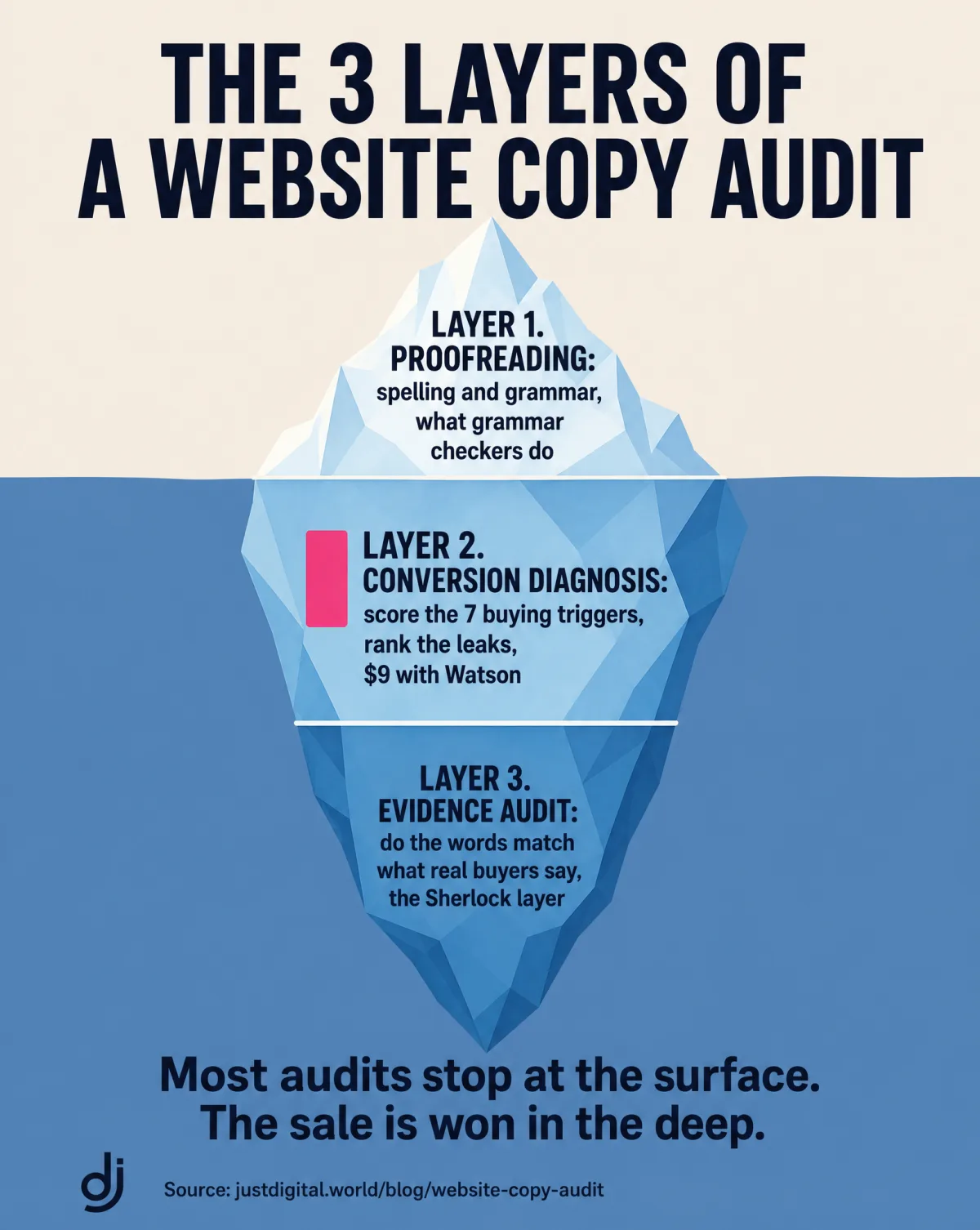
A complete copy audit runs 3 different checks: correctness, conversion, and evidence. Every page ranking for "website copy audit" collapses them into one, which is how founders end up believing a grammar pass counts as an audit. The layers have different jobs, different tools and different prices.
Layer 1: The Proofreading Pass
Layer 1 checks the writing is correct: grammar, spelling, consistent terms, working links. Grammar checkers handle this well and cheaply, and it's table stakes. Run it, and know what it proves: nothing about sales. A page can pass every correctness check and still lose every visitor, written correctly.
Layer 2: The Conversion Diagnosis
Layer 2 asks whether the page triggers a buying decision. This is the layer that finds the line losing the sale, and it needs a framework rather than taste.
Watson is that framework, packaged. It investigates your homepage or landing page, scores the 7 psychological buying triggers on the page, ranks the leaks by what they cost you, and names the first fix. $9, one time, no subscription. The report is in your hands in about 10 minutes and reads in about 10 minutes. It runs inside Claude; setup takes about 2 minutes with the included guide, no technical skill needed. Vanjo, founder of Wolkk, after running it: "I was shocked how accurate this was."
Layer 3: The Evidence Audit
Layer 3 asks the question neither software nor a red pen can answer: do the words on the page match the words real buyers say? Copy converts when it echoes the language buyers already use about their own problem, and no prompt can supply words the model never had.
This is Sherlock's layer. Sherlock builds the Customer DNA report: the full psychological profile of your real buyers, from their own words in reviews, testimonials, calls and support threads. It's the paid deep-research step after the diagnosis; pricing is on the product page. Lestrade, the intake interviewer, stays free and unlimited, and it's where you start if you've never mined your buyer language at all. The message testing guide shows this evidence layer working on a live account.
| Layer | Question it answers | Tool | Cost | What it cannot catch |
|---|---|---|---|---|
| Proofreading | Is the writing correct? | Grammar checkers | Free to low | A page that sells nothing, written correctly |
| Conversion diagnosis | Does the page trigger a buying decision? | Watson (7 buying triggers) | $9 one time | The words your buyers actually use |
| Evidence audit | Do the words match real buyer language? | Sherlock (Customer DNA report) | See getsherlock.io | Grammar and structure |
How Do You Run a Website Copy Audit Yourself?
Run the self-audit in 5 steps, and treat every no as a leak. You need one page, one hour, and the checklist below. No tool required.
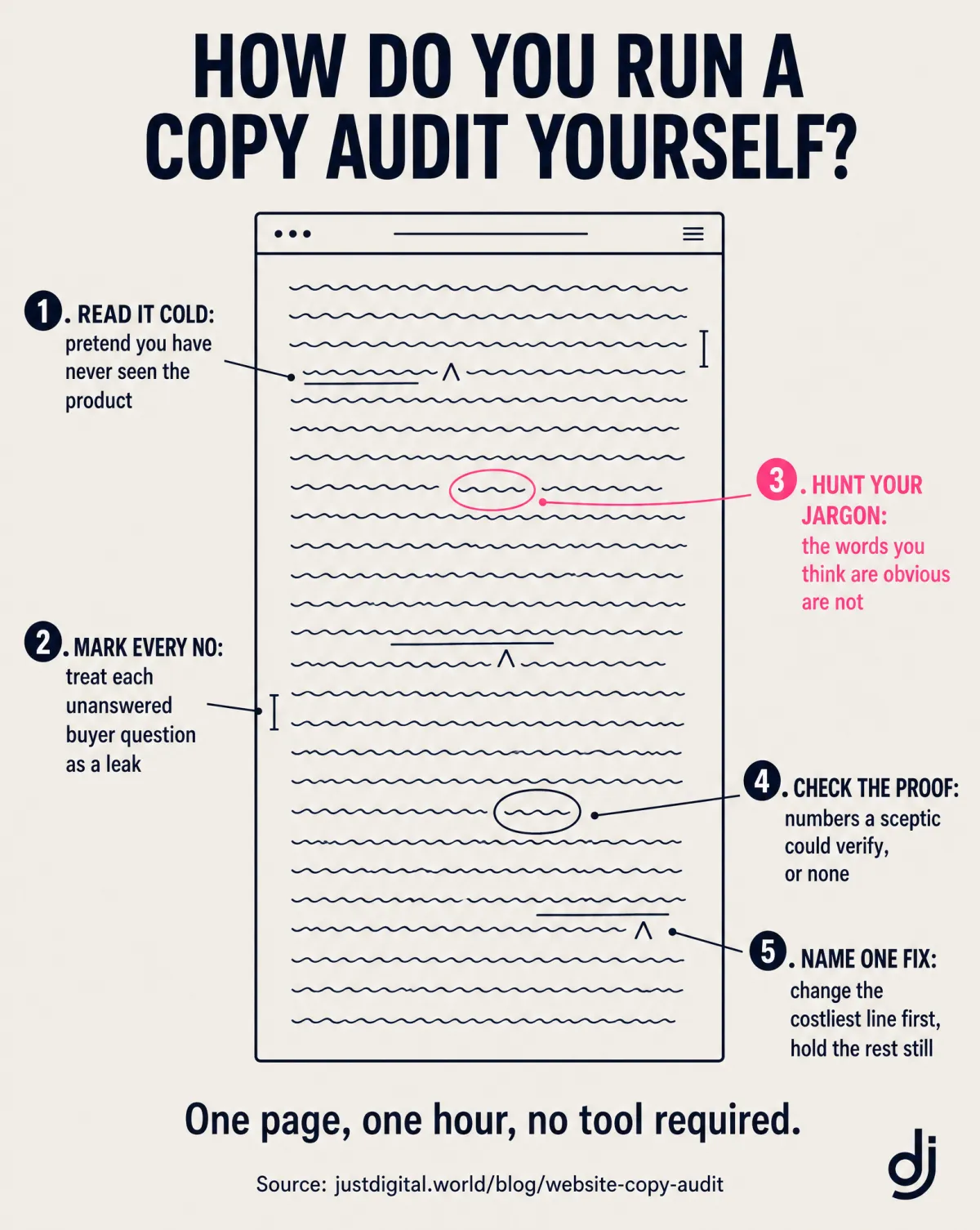
- Pick the money page. Audit the one page that carries the revenue: for most SaaS founders the home page, for a service-based business usually the services or sales page, and for anyone running ads, the landing page your bottom-of-funnel keywords point at. One page audited properly beats skimming every page of your website; the other key pages get their turn once the money page converts.
- Audit above the fold first. First impressions happen in the scan. Nielsen Norman Group's reading research found 79% of test users scanned any new page and only 16% read word by word; rewriting pages to be concise, scannable and objective measured 124% better usability. Your hero section decides whether anything below it gets read. Spend half the audit there.
- Score the current copy against the 7 audit questions. These are the dimensions Watson scores; the full list is below. Answer each with a plain yes or no. One no = one leak. No partial credit: "sort of" is a no.
- Rank the leaks. Weigh position against money: a leak in the headline outranks a leak in the footer, and a leak on the pricing section outranks both if that's where buyers stall. You're deciding what to fix first, in money order.
- Fix the top leak, then re-read as a stranger. Read the page aloud. Where you stumble, the reader already left. Implement the changes one leak at a time: fix everything at once and you'll never know which fix worked.
The 7 audit questions:
- Does the first line name a problem the buyer recognises as theirs?
- Could a stranger say what you're offering after one read?
- Is there a number or proof point a sceptic could check?
- Does it answer the buyer's biggest recorded objection?
- Would your competitor's unhappy customer see a difference here?
- Is the next step obvious and priced?
- Would the buyer recognise their own words anywhere in it?
Now the limits: what the self-audit will not catch. The curse of knowledge doesn't lift because a checklist arrived. You will pass your own jargon, because to you it isn't jargon. And question 7 needs recorded buyer language you may never have mined. Fresh eyes fix this, which is what a copywriter charges four figures for; a self-audit is useful and structurally biased in your favour, which is the case for spending $9 on an external diagnosis instead of another weekend on rewrite number 9.
What Does a Copy Audit Find on a Real Hero Section?
The before-hero below fails 6.5 of the 7 audit questions, and it reads perfectly fine. It's a constructed example of the pattern, not a client's page; if it looks like every AI-drafted SaaS hero you've seen this year, that's the point.
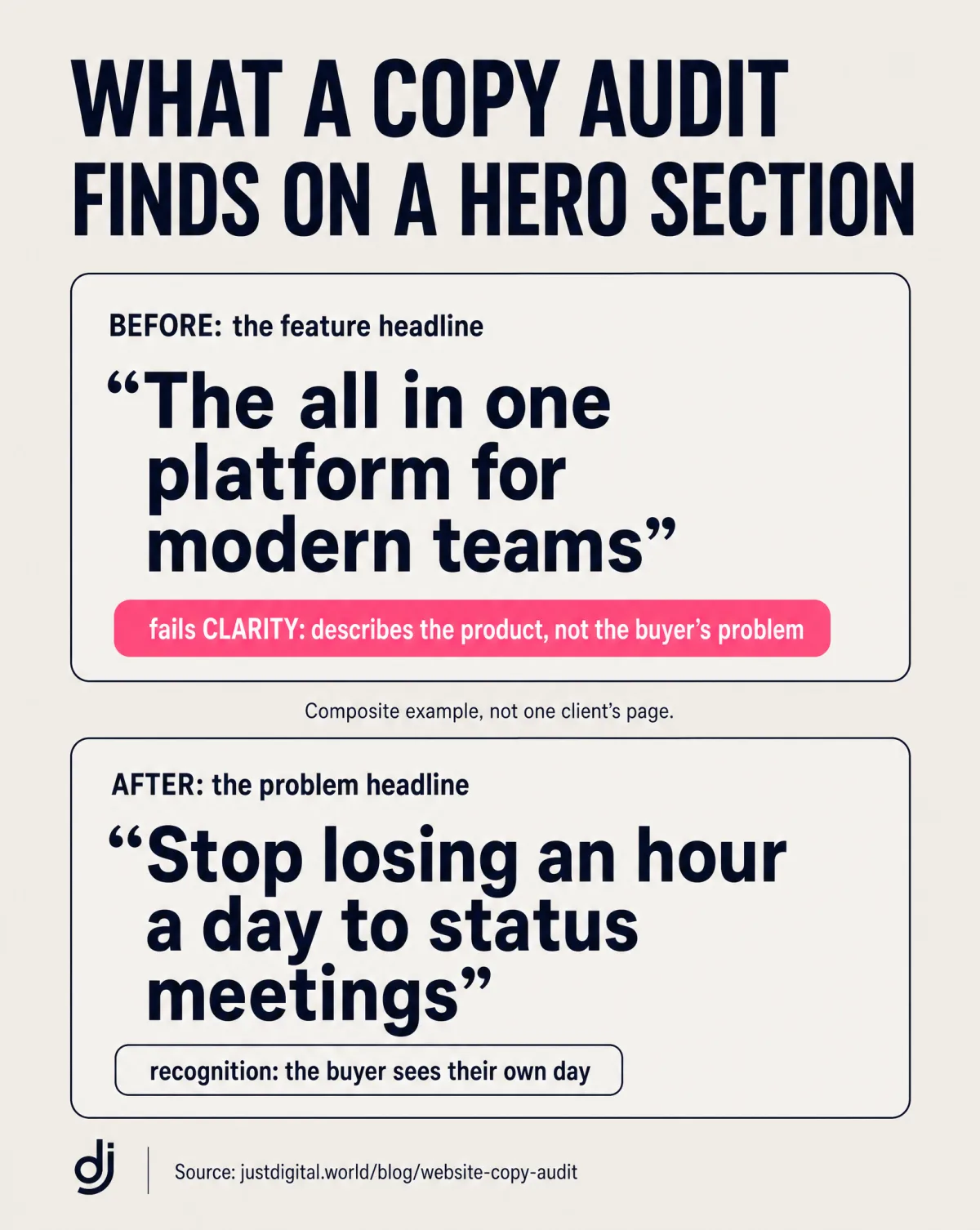
The before version:
Effortless Client Onboarding, Reimagined. Our AI-powered platform streamlines your workflow so you can focus on what matters most. [Get Started] [Learn More]
Run the questions. Q1: no problem named anywhere; "effortless" is an adjective, not a situation. Q2: a stranger cannot say what this company sells; "platform" and "workflow" fit 10,000 products. Q3: not one checkable number or proof point. Q4: no objection answered; there's nothing concrete enough to object to. Q5: your competitor's unhappy customer would see nothing different here, because their vendor's hero says the same thing. Q6: half a point; "Get Started" is a next step, but it's unpriced, and "Learn More" competes with it. Q7: these are vendor words. No buyer has ever said "reimagine my onboarding".
The after version, rebuilt line by line from the diagnosis:
Stop chasing clients for files and logins. One link collects the documents, forms and signatures for you, and chases the stragglers so you don't have to. [See a 2-minute demo]
| Line | Before | Audit finding | After |
|---|---|---|---|
| Headline | "Effortless Client Onboarding, Reimagined." | Fails Q1, Q7: no problem, vendor words | "Stop chasing clients for files and logins." (the problem, in buyer words) |
| Subline | "Our AI-powered platform streamlines your workflow..." | Fails Q2: a stranger can't restate the offer | States what it does and for whom, concretely |
| Proof | None | Fails Q3, Q4: nothing to check, nothing answered | The slot now exists; fill it with a sourced number or a named customer's words |
| CTA | "Get Started" + "Learn More" | Fails Q6: competing, unpriced | One CTA, timed ("2-minute demo") |
Two caveats. The after-version is a better diagnosis, and a diagnosis is all it is: no rewrite comes with a promised result, and you should message-test it before betting the quarter on it. And its headline only works if "chasing clients for files" is what this product's ideal clients actually complain about: the rewrite is only as good as its evidence, which is layer 3's whole argument. Guessed buyer words are still guesses, the same way guessed keywords lose to buyer-language keywords.
This diagnosis is what Watson automates: same dimensions, scored and ranked, with the first fix named. Anton, founder of MVP Gurus, put it plainly: "It's done what would take hours and an expert to do."
What Does a Website Copy Audit Cost?
Professional website content audits run $1,000 to $5,000; Watson runs the conversion-diagnosis layer for $9, one time. Those are the real numbers, printed, which is more than most pages on this topic will do for you.
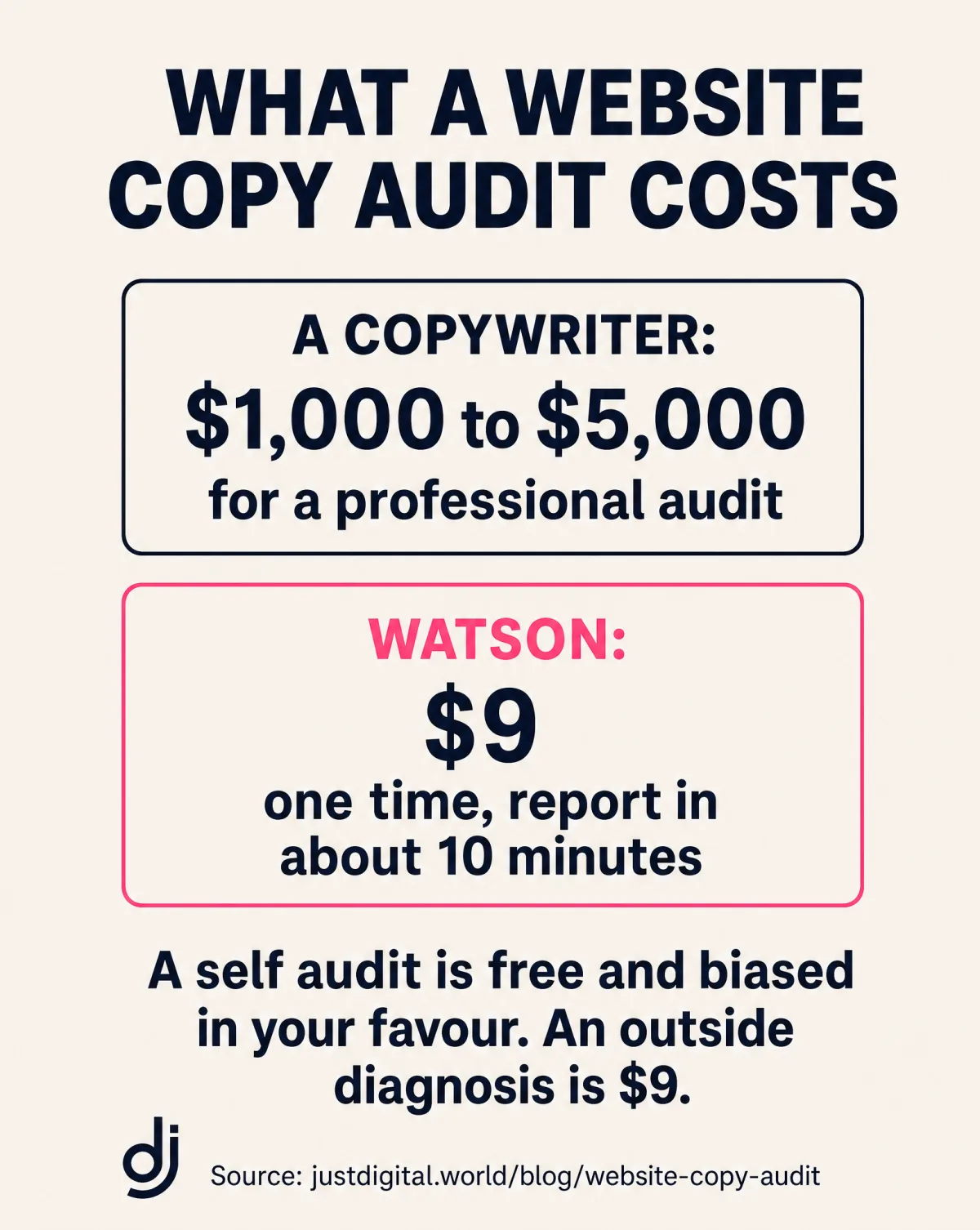
The $1,000 to $5,000 band comes from a current copywriting rate roundup for a full website content audit. The audit services ranking for this very keyword mostly don't print prices at all; the quote arrives on a call. A full website copywriting service (the rewrite, not the audit) sits beyond audit scope entirely, at four figures and up depending on scale, per the same guide's project rates.
| Level | What you get | Cost | Time |
|---|---|---|---|
| Self-audit | The 5 steps and 7 questions above | Free | An afternoon |
| Watson | 7 triggers scored, leaks ranked, first fix named | $9 one time, no subscription | About 10 minutes |
| Professional audit | A copywriter's comprehensive analysis of your site's copy | $1,000 to $5,000 (rate roundup) | Days to weeks |
| Full rewrite | New copy, not an audit | Four figures and up | Weeks |
What the $9 actually buys: the Watson report (triggers scored, leaks ranked, first fix named) plus one full run of every other tool in the agency: Sherlock (Customer DNA), Moriarty (competitor teardown), Virtual Dom (marketing coach), Growth Opportunities (market sizing), and Google Quality Rater (SEO check). Lestrade, the intake interviewer, stays free and unlimited.
And the guarantee, exactly as the product page words it: "Try it without risk. Run all 6 tools once each. If you don't find a single thing worth changing in your marketing, reply to your receipt and get the $9 back."
A sensible rule for this table: never pay more for the audit than the ad budget it protects. For most founder pages, that rules the four-figure row out and leaves you choosing between an afternoon of self-audit and a $9 report that arrives in about 10 minutes.
Ready to Audit Your Page? Run Watson for $9
What Happens After the Audit?
An audit finds the leak; buyer language writes the fix. That division of labour matters, because the most common post-audit mistake is rewriting the failing line with the same guessed vocabulary that produced it.
The durable sequence looks like this. First, rebuild the failing lines from words real buyers say: mine your reviews, sales-call notes and support threads for the phrases that repeat. The same questions later work on your email sequences and lead magnet pages, but the money page comes first. Sherlock automates this as the Customer DNA report, built from your buyers' own words. Second, message-test the rebuilt promise against your old control and let the live account judge. Testing the message before the budget commits is validated practice: the Advertising Research Foundation's Copy Research Validity Project, checked against real split-cable sales results, found its strongest measure picked the better-selling ad in 84% of pairings.
Where you go next depends on where you stand:
- No recorded buyer language at all? Start with Lestrade, the free unlimited intake interviewer. It costs nothing and gives layer 3 something to work with.
- Leak found, fix unclear? That's Sherlock's case: the Customer DNA report turns your buyers' own words into the raw material for the rewrite.
- Want it done for you? The studio takes a small number of engagements; message Dom on LinkedIn.
One more thing before you spend the budget the audit just protected: rented traffic gets recalled, owned audience compounds. The public receipt for that lesson is what happened to justinwelsh.me, a site that grew its organic traffic about 480 times and then lost roughly 94% of it in six months of core updates. Audit the page, fix the leak, and point the traffic you earn at a list you keep.
Conclusion: Audit Before You Spend on Traffic
Three takeaways for the founder about to rewrite the page a ninth time. Separate the three layers: a copy checker is not a copy audit, and passing one is not passing the other. Diagnose with a framework, not taste: 7 questions, one no per leak, fix the top leak first. And rebuild the failing line from buyer words instead of fresher synonyms.
The maths is short. The diagnosis costs $9 and about 10 minutes. The ad campaign pointed at an unaudited page costs whatever it costs, multiplied by every leak still on the page. Audit before traffic.
Run Watson: $9, one time, first fix named in about 10 minutes.
Frequently Asked Questions
How long does a website copy audit take?
The self-audit in this guide takes about an afternoon for one page. Watson's report is in your hands in about 10 minutes and reads in about 10 minutes. Professional audits run days to weeks. Note: the fix always takes longer than the finding; that's normal, not a sign the audit failed.
Should you audit copy before or after running ads?
Before. Ads multiply whatever the page already does, leaks included. At small-site traffic an A/B test can't referee copy anyway (you won't reach enough users per variant for a verdict), so diagnose the page first, then spend. Run the audit the week before the campaign goes live.
Do you need traffic data before a copy audit?
No. A copy audit judges the page as written: promise, proof, objections, call to action. Analytics tells you where visitors leave; the audit tells you why. However: if you already have recorded buyer language (reviews, calls, support threads), bring it. It powers the evidence layer.
Is there a free website copy audit?
Yes, two real ones: the 5-step self-audit above, and Lestrade, the free unlimited intake interviewer. However: many free "audits" from agencies are discovery-call funnels; check what's being sold before you accept one.
What do you get in Watson's $9 report?
The 7 buying triggers scored on your page, the leaks ranked by what they cost you, and the first fix named, in about 10 minutes. The $9 also includes one full run of every other tool in the agency: Sherlock, Moriarty, Virtual Dom, Growth Opportunities, and Google Quality Rater. "Try it without risk. Run all 6 tools once each. If you don't find a single thing worth changing in your marketing, reply to your receipt and get the $9 back."
How much should a website copy audit cost?
Self-audit: free. Watson: $9, one time, no subscription. Professional website content audits: $1,000 to $5,000 per current rate roundups. However you price it, keep the rule from the cost table: never pay more for the audit than the budget it protects.
Can ChatGPT audit your website copy?
A general model can proofread and comment, but it grades on the same fluency it writes with. A 2023 PNAS study (6 experiments, 4,600 participants) found people can't reliably tell fluent AI text apart, and neither can their intuitions. A diagnosis needs a fixed framework scored against the page: that's what Watson runs, for $9.
What is the difference between a copy audit and a website audit?
A website audit covers the whole site's technical health: crawling, speed, SEO, user experience. A website copy audit covers the message on one page: promise, proof, objections, CTA. Run the copy audit when traffic arrives but sales don't; conduct a website audit when traffic itself is the problem.
Get Updates Like This
Case studies and teardowns like this one land in the newsletter first, alongside AI marketing that converts and SEO that converts better. You get the receipts as they happen. I won't spam you, I promise.
Sources
- Oppenheimer, Consequences of Erudite Vernacular Utilized Irrespective of Necessity, Applied Cognitive Psychology, 2006 (five experiments on complexity and judged intelligence; 86.4% self-complication figure)
- Heath and Heath, The Curse of Knowledge, Harvard Business Review, December 2006
- Jakesch, Hancock and Naaman, Human heuristics for AI-generated language are flawed, PNAS, 2023 (6 experiments, 4,600 participants)
- Nielsen Norman Group, How Users Read on the Web (79% scanning; 124% usability improvement)
- SEO Copywriting Services, SEO Copywriting Pricing Guide, 2026 (website content audit range, $1,000 to $5,000)
- The ARF Copy Research Validity Project, Journal of Advertising Research (84% pairing accuracy against split-cable sales)